Contents
"Unorganization: The Travel Dispatches" contains the following sections:
Introduction
Unorganization Ratings
Humanity
Quality of life
Safety
Government
Prosperity
European Union
BELGIUM
European Commission
Brussels Transportation
Brussels Geography
Brussels People
Lovin’ Leuven
Summary
Unorganization Rating
FRANCE
A protest in Paris
Paris: Ou est la centre de la ville?
Unorganization Rating
GERMANY
Living in Germany
Studying in Germany
- Working in Germany
Unorganization Rating
PORTUGAL
Conflict at the Hotel Tivoli Lisboa
Unorganization Rating
REPUBLIC OF IRELAND
Dublin
Drogheda
Unorganization Rating
ENGLAND
Newbury
London
Birmingham
Unorganization Rating
Scandinavia
NORWAY
The follies of a train journey across Norway
Unorganization Rating
DENMARK
Around Copenhagen
A real example of excessive office regulations in Denmark
Unorganization Rating
FINLAND
Espoo
Unorganization Rating
SWEDEN
Company Canteens
Unorganization Rating
Eastern Europe
HUNGARY
Hungry for money in Hungary
Unorganization Rating
CZECH REPUBLIC
Around Prague
Unorganization Rating
SLOVAKIA
A protest in Bratislava
Unorganization Rating
POLAND
The Warsaw Packed
Unorganization Rating
Africa
SOUTH AFRICA
Sandton
First Day Notes
Midrand
Unorganization Rating
The United States of America
Miami 1992
More Bust than Dave at Dave & Buster’s
I like driving in my car…
Credit Records… "Do not honor"
Baseball and Community
Unorganization Rating
Asia
JAPAN
The separate lives of men and women
Work organization in Japanese offices
Understanding meetings in Japan
Appalling Customer Service
Difficulties in making telephone calls in Japan
Route 18: The Americanization of Nagano
Recommendations for unorganizing Japan
Unorganization Rating
HONG KONG
Courier Company
Lantau Island
Unorganization Rating
CHINA
Zhuhai
Guangzhou
Shenzen
Unorganization Rating
MACAU
Unorganization Rating
Feedback
Appendix: Travel Schedule
This version of Unorganization: The Travel Dispatches is a shorter version of that which is incorporated in the Complete GeoPolitical Unorganization book on unorgan.com. The later includes the Overall Unorganization Ratings- it collates the analysis carried out in the last part of this book and forms league tables on the basis of it.
Introduction
I have always been very fortunate to be able to travel overseas. Even as a teenager, the sun and sand of the Mediterranean were much more familiar to me than the pebbles of my home country’s beaches. Since graduating and starting to write unorg, I have been making 15 to 20 trips per year, mostly for work. Many of the reports in this book were from travel during 1998- all have been since I started unorg in 1995. (I have listed all the trips I have made in the Appendix to this book).
"Unorganization: The Travel Dispatches" is a personal report based on my own observations of the countries and places and people I have visited and met and my interpretations of them. I have only written about countries I have visited and as such, all the material is a first hand account. Most of these accounts are however based on short stays and the treatment that you get at airports and from taxi drivers is not necessarily the same that you would get as a local living in that place. I have tended to draw my conclusions about these places on the basis of these short stays- and I certainly feel that there are some places that I would not want to go back to on the basis of what I saw first time around. However, these inevitable difficulties aside, I have assessed every place in the same way such that the accounts have comparative value. I am confident that they contain a lot of truth, because I enjoy the stimulation of being abroad in new environments and this encourages me to miss nothing and be interested in everything.
Some of the material in this book was initially published as "Dispatches from the unorganized world" (See www.unorgan.com/weekly.htm). However, the material been significantly expanded to include many other general observations and reports from nearly all the countries I have visited rather than just a few.
At the end of each section, I have included an unorganization rating which accesses the extent to which the place is convivial to someone who shares the philosophy behind unorganization. The idea is to compare the places and create a guide that rates each place that I have visited relative to the others. The question the unorganization ratings try to answer is "So where would a humanitarian-libertarian alien coming to Earth for the first time like to live?" A rating out of 10 is given which is based on the factors listed in the next section such as humanity, quality of life, government, safety and prosperity. A league table is then included in the final section before the appendix. I intend regularly updating these ratings.
One last introductory point: there are many other places I am going to go: South America, Australia, New Zealand, India, the Middle East, so watch for updates to this book which will be published on unorgan.com over the next few years!
Unorganization Ratings
- At the end of each section, I have assigned the countries an unorganization rating. This is intended to express relative differences between places and rate them according to their progress towards being unorganized and sharing the spirit and philosophy behind unorganization.
The rating out of 10 is assigned according to the following criteria:
HUMANITY. The way that people interact with and respond to other people- friends, other nationals and overseas visitors. (Weighting: 3 from 10).
QUALITY OF LIFE. The way that people live their life- where they live, where they work, how they socialize. Includes factors like social systems such as medical care (health) and schooling (education). (Weighting: 2 out of 10).
SAFETY. The extent to which people are safe in their everyday life and have to worry about safety concerns. (Weighting: 2 out of 10).
GOVERNMENT. The extent to which the government intervenes in and interferes with people’s lives. (Weighting: 2 out of 10).
PROSPERITY. The extent to which people can prosper, retain the rewards from their hard work, cope with and recover from a lack of prosperity. Prosperity here relates to financial prosperity. (Weighting: 1 out of 10).
Clearly, these factors are inter-related, with for example, links between prosperity and safety and quality of life and government and government and prosperity and humanity and safety. An Unorganization Rating of 10 would obviously mean an unorganized utopia- a place where I would love to live!
Let us now begin our world tour and search for the most unorganized countries and places.
European Union
BELGIUM
"The problem with Brussels is that too much of what it sprouts is vegetable and too little mineral." Simon Buckingham.
I visited Brussels, Belgium for the first time in November 1998, just a few weeks before the introduction of the single European currency, the euro. I am fiercely opposed to the euro (see www.unorgan.com/europe.htm for more details on my views). Hence, I was interested to visit the city where the European Commission and other European Union institutions are based.
As soon as we disembarked from the airplane at Brussels airport, we got onto a bus that took us to the airport terminal. The bus doors opened and there was a narrow metal walkway that lead to a revolving door that forced people to walk in single file. A sign next to the revolving door then said "Maximum 3 persons". Once you got inside the revolving door, there was a sign with a picture of some hands against the glass in front and a line through it, in other words, do not push the door. I was amazed by these restrictions- I detest revolving doors anyway- they simply prevent people from easily entering a building. Think about the person who designed this door- it would not surprise me to find that they were a murderer- because they clearly do not assign any value to human freedom.
As soon as I arrived at my hotel in Brussels and checked in, the hotel receptionist handed me a form to fill in. The top of the form explained (in both Dutch and French, the two official languages of Belgium) that its completion was pursuant to a 1965 decree to control travelers staying in hotels. I was expected to provide detailed information such as my full home address, nationality, passport or identity card number, birthplace, profession and so on, as well as some very detailed information such as my maiden name and means of arrival at the hotel!
EUROPEAN COMMISSION
Pretty soon after arriving in Brussels, I headed out to the European Commission area. As soon as I got out at a nearby underground train station, I saw an amazing sign (in Dutch and French) that made me laugh. It read:
"PAR ORDRE DE POLIC
Il est strictment interdit de deposer de la nourriture pour les pigeons et les mouettes"
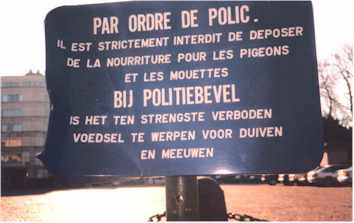 |
Which roughly translated means that "By order of the police, it is strictly forbidden to deposit food for pigeons and something else".
I then traversed a big arc celebrating the independence of Belgium (something else that made me laugh!) until I got to the European Commission building itself which was wrapped in a giant white plastic sheath (something else that made me laugh!). There was a giant cream polythene wrap hugging the building.
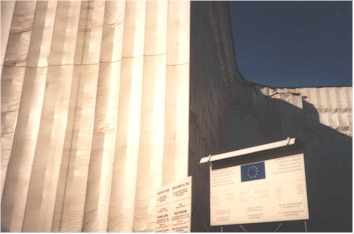 |
To get to the Commission building, I passed no less than nine armored vehicles each full of police and army personnel, some of whom seemed to be SLEEPING! (especially the ones in the comfortable front seats). There were about 10 people in each van, so I wonder how many guards there are when the building is actually in use!! Yes, that’s rights, there were nine armed riot vehicles defending a sheath!!!! The nine vehicles comprised :
two police vans with wire mesh on the front window apart from a hole where the driver looked out
six smaller army vehicles with windows out of the side and
one very large army vehicle with no side windows and large spotlights and so on on top of it.
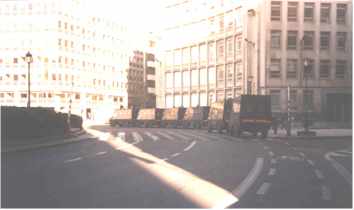
A sign in the nine official languages of the European Union told me that the building was being renovated. My Brussels tour book told me that the building had been closed because of the danger to the health of the personnel caused by asbestos in the roof. I had wondered what had warped the "brains" of those despots. A sign told me that the work was for the:
"Renovation d’un immeuble de bureaux de 14 niveaux destine a la Commission Europeenne, comprenant 127.895 m2 hors sol."
There will be very few days in my life when I can say the European Commission has made my day, but this was definitely one of them- but it is not a cheap laugh unfortunately.
On my way back to Brussels central station, I came by chance across a group of about 50 people, mostly men, carrying what looked like anti-immigration posters. Certainly I saw the letters "immig" and all of them were light skinned. I did not bother to follow them as their cause was not a just one.
A couple of days later, I happened to be sitting in the Swiss Hotel in central Brussels and next to me was someone from Gordon Brown’s office. Brown was at the time the finance director in the UK government. The aide was explaining to the office of Neil Kinnock, the European Union Transport Minister, that Mr. Brown had been delayed for their meeting. Brown and Kinnock are both socialist Labour politicians (someone ought to tell them that two wrongs do not make a right). Eventually, Brown himself came down and helped himself to four boxes of Belgian chocolates from a stand in the hotel reception. I wondered whether they were being put on his bill or mine.
BRUSSELS TRANSPORTATION
During my Brussels visit, I used various different forms of transport:
Taxis
I took quite a few cabs during my stay in Brussels for the sake of speed, convenience carrying things and when I was familiarizing myself with the layout of the city. Cabs took along time to arrive (a 15 to 20 minute wait) and in many cases they did not know the places I wanted to go. I got the feeling that they were used to go to set places- maybe funneling bureaucrats and other stuffed suits between hotels and central offices.
Underground trains
As so often is the case, the underground railway stations were depressing- orange and gray and quite dimly lit. Plastic and marble dominated. When you got on board, the seat tops were really high so that you could only see the people sitting around you and no-one else. There were not designed by human beings for human beings, who are naturally inquisitive about other people. When you arrived at the destination, the doors had to be opened manually using a lever to release them.
Trams
At least the trams and underground trains shared stations- you could easily get off a train and onto a tram to complete your journey. The person rightly mattered more than the specific form of transportation. Trams and stations carried "Child Focus" posters showing photos of missing young people and giving a description of them.
Local trains
The local train that I took from Brussels to Leuven (see below) was fine- warm at least- except that it stopped at many stations for a long time- three or four minutes at each despite few passengers getting on or off. Reducing the stationary time spent at each station could rapidly reduce total journey times with little or no inconvenience to any passengers.
I did see some new cars being transported in bulk by rail which I thought was a good idea. On the other hand, some of the rail tracks coming out of the Stella Artois plant in Leuven had been partially concreted over.
Inter City trains
The train that I took from Leuven back to Brussels was very high quality- it was comfortable, modern, new, had great d'cor, was well designed with a pleasant color scheme. Each seat in the standard class accommodation had its own table, foot rest and arm rest, with a waste paper bin shared by two persons. There was plenty of space too- passengers could stretch out. An electronic bulletin board showed where we were heading in LARGE easy to read writing overhead. These trains may be state owned, but they were really nice.
BRUSSELS GEOGRAPHY
On my way in a taxi to a meeting in central Brussels, we passed:
beggars with pots and signs asking for small change at many traffic lights
signs at the banks counting down the number of days until the arrival of the euro (there are many, many banks in Brussels)
representative offices for many large corporations
a big metal and glass headquarters for some international trade union organization
lots of shops, all of which seemed to have different opening hours. They seemed to opened for afternoons, occasionally, until late at night and so on. This was the first time I had noticed the irony in naming a chain of betting shops "Ladbrokes"! This is an English based chain that was widespread in Brussels. The post office was closed on Saturday, but fortunately some shops selling postcards also sold stamps.
interim employment agencies seemed to be big business in Brussels- they were everywhere- these are companies that specialize in placing workers on short-term contracts.
BRUSSELS PEOPLE
It was immediately obvious that Brussels was a city made up of many different nationalities and that there are a lot of immigrants. I also formed an early impression that Brussels was an ugly city full of ugly humorless people. Many people were wearing clearly expensive clothes and a lot of make up. I did later have a walk around the central Brussels area where the various old monuments and buildings. There were certainly some fairly good looking buildings in this area.
A far higher proportion of the Belgian people than anywhere I have visited seemed to be unfriendly and humorless. Many of them seemed to be completely devoid of any visible signs of humanity:
A girl selling refreshments in a shop (in Leuven) refused to give me EMPTY PAPER Coca-Cola cups even when I was buying one size of drink and showed her the photos of my collection (See www.BottleBank.com). She said to me "No, we cannot do that. You have to pay for it". She shook her head as if to say stupid customers when I first handed the empty cups to her.
A man looking after a shop selling newspapers was rude to me and refused to do much more than pull nasty faces at customers. I left the door ajar ("Don’t you think its cold enough today already"), I asked for directions somewhere, I asked after a certain magazine and just the general location was pointed out to me. If only I could reproduce for you this person’s facial expression.
I boarded a train and asked the attendant whether the it was going to Leuven. He categorically told me that it was the wrong train yet the platform sign was showing Leuven. I got off the train and had to wait another 40 minutes before the next one. This person could only have been deliberately lying to me, he must have known where the train was heading as he was on it himself. He was simply mean spirited and lacking in human tolerance and compassion.
I visited a chocolate factory to collect some product samples for a friend of mine who runs a chocolate shop in the UK (Belgium is renowned for the quality of its chocolate). I went to the factory on Friday afternoon and was told by the receptionist that the person I needed to speak to was at lunch. I asked what time the factory closed and was told 5 p.m. I arrived back at ten minutes before 5 after another meeting only to find the reception locked and closed and to be told that on Fridays, the plant in fact shut at 4 p.m. I gave the people my business card and told them that I would be back on Monday to collect some samples then. On Monday, I made another visit to the factory en route to the airport. A different receptionist was working that day.
She called the person I needed to speak to- the district sales manager- who came down to reception and told me that he had some samples I could take. He led me to the storeroom with a form to sign out any items that were taken. He went into see the stock keeper in his room and I followed him, only to be asked to remain outside (there was a sign on the door that I had not seen saying no unauthorized access). The district sales manager spoke with the stock keeper and came back out making the comment to me that the stock keeper was already very busy.
We went into the stock room and selected a few different items such as the special Christmas chocolates that seemed to the promotion of the moment in Belgium. The stock keeper then came in and started arguing with the district manager and saying that I could not take the Christmas items (other items were OK, but the Christmas ones did not appear to have a stock code for being recorded on the inventory form). They were arguing loudly, snatching things from my bag and each other’s hands as the sales manager tried to get the items for me and the stock keeper absolutely refused. The sales manager then called someone in authority on his mobile phone and was given the go ahead to let me have the Christmas items. The stock keeper then immediately ceased all opposition and helped me to collect some other samples. At the end of it, the sales manager thanked the stock keeper with a handshake and we left.
I felt mauled and let out a sign of relief upon leaving the stock area. This amazing scene taught me a few things. I had to come back to the plant three times before I got any action. I was lucky enough to find a human being in the district sales manager who did everything he could to serve his customer despite the lack of humanity in his colleagues. These people were arguing and nearly fighting in front of a stranger from overseas. Frankly, I was shocked and embarrassed at having caused this disturbance.
I feel that reward for outstanding performance is essential and so too is accountability for poor performance. So I wrote the incident up in a letter and when I rang the factory to request the name of the General Manager, I was told that they could not give out any names. Maybe we can put this whole sad episode down to the bureaucracy of Belgium. If I treated external callers with such defensiveness and negativity, I would not want to give my name out either.
I am not saying that there are not some friendly people in Brussels- I simply did not meet any. I sometimes felt so rudely and badly treated that I did not even bother to approach other people for help- such as to request a plastic bag to replace a split one- because I was fearful of the coldness and hostility I would face. This really is the sign of an uncivilized society.
You know what they say, finish with a positive, so here goes:
LOVIN’ LEUVEN
It was because a friend of mine moved out to work in Brussels and live in Leuven and a business contact of mine worked there that I got to hear about and visit Leuven, a town 25 kilometers outside of Brussels. Known as "Louvain" in French speaking parts, Leuven is in fact in the Dutch speaking part of Belgium.
I really liked Leuven, not least because of:
Stella Artois. The huge brewery for this leading lager was based there.
Shopping. Leuven had endless shopping streets, including all my favorites such as Marlboro Classics, Citibank, international press stores and so on. There were lots of toy shops for all the children I saw around and plenty of bars and restaurants too. There seemed to be a strong American influence, with plenty of American bars and gift shops. Queues in supermarkets always seemed to be 10 people deep in Leuven and elsewhere in Belgium (the duty free shops at Brussels airport, for example).
University. The catholic university of Leuven provided education for thousands of students from around the European Union and beyond.
Women. The women were great looking, much more so than in Brussels.
Architecture. Some stunning architecture could be found in Leuven, in particular in the Grote Platz area.
Something else that was interesting in Leuven was the stickers on many people’s letterboxes saying:
"GEEN REKLAME WEL advertentie- en Informatiebladen a.u.b"
In other words, I do not want to receive any free leaflets or advertisements.
Leuven was one of those places that has a good atmosphere such that you immediately feel comfortable and at home there. I would recommend a visit to anyone. The town has its own Internet site at www.leuven.be.
SUMMARY
I personally had a fantastic short four-day visit to Belgium with much business success and observations made and things learned. But I would really not like to live in Brussels with its climate and population and traffic and ugly humorless people. I would love to go back and spend more time in Leuven though. It was quite clear to me that whilst Brussels may be a relatively prosperous place financially, in no way could this be equated with human development. The people were under-developed mentally and physically and spiritually. Europe would be a better place without what Brussels sprouts. The problem with Europe is that too much of what it sprouts is vegetable, and not enough mineral.
UNORGANIZATION RATING
HUMANITY: 0. There was little discernible courtesy or kindness towards other people.
QUALITY OF LIFE: 1. Belgium was very cold over there in climate terms. People tend to live in flats. There seemed to be a lot of cultural events going on and many restaurants and bars.
SAFETY: 2. Belgium is a safe country, in keeping with many others in Europe.
GOVERNMENT: 0. Belgian people suffer from having their own active government and the European Commission in their country.
PROSPERITY: 0.5. People seemed relatively wealthy- I saw lots of fur coats and expensive clothing and cars.
TOTAL: 3.5 out of 10. Belgian would probably be survivable in Leuven, but working and living in Brussels is not a pleasant thought.
FRANCE
Most of the time I have spent in France has been in Paris- I have been there on several occasions. I wrote the poem below based on observations I made traveling from the Gard du Nord railway station (where I was dispatched by the Eurostar cross channel train) to the center of Paris which was very different. As with so many of the places described in this book, Paris has both an old town and a new town, and the lifestyle and people in each of those places varies significantly. The center of Paris has wonderful geography with great architecture and wide roads, often with strips of grass running along the center of the road and with trees along the pavements. Taking a taxi across the center of Paris over the hobbled streets through arches and past statues is wonderful, akin to traversing Pall Mall and passing Buckingham Palace in London.
Paris strikes me as a city that wakes up late- I was once wandering around for a couple of hours before the city started moving. Paris just seemed more relaxed than other cities such as London.
I have rarely experienced any unfriendliness or aloofness from Parisians- I have always tried to use a little of their language to ask for directions and this seems to go down well with the locals who appreciate the effort being made. I was once ignored by a shop assistant in a shop close to Paris University and I still remember that rudeness. I did see some standoffish behavior- particularly when causally dressed outsiders visited offices to pay bills and drop off goods. On one occasion, I was ignored by one office receptionist and kept waiting for half an hour before being served because I had turned up without any appointment. I then met a wonderfully friendly and humane receptionist at that same place who took pity on me and was exceptionally friendly and helpful to me. Of those two people sitting behind that reception desk, I had the misfortune of dealing with one who was clearly unhappy, and the luck of dealing with one who treated me like a worthwhile human being.
A PROTEST IN PARIS
I was wandering the streets of Paris at five o’clock in the afternoon on the 28th of January 1998, when I came by chance upon a street protest in the rue d’Anjou in the 8th district. The protest was being made by a trade union called Syndicat Autonome du Personnel de la Compagnie Generale des Eaux (CGE) representing employees of CGE, a large utilities company in France. The protest was being held because the employees wanted to work for 35 rather than 39 hours per week.
About 200 people had gathered in this side street to protest, with a police car at either end of the street blocking off access to it to vehicles. The protesters were predominately in their 40s, nearly all casually clothed men with glum and serious faces. The air was very cold and thick with smoke- this was clearly not a party.
After a man with a beard had made a speech over the megaphone, the 200 or so people began to splinter. A group of 30 or so people remained in the side street and listened to a short speech by another union official identified as such by his light blue jacket. A short debate then ensued with a few people in the group arguing their points of view.
These 30 or so protesters then walked the short way down the street to Boulevard Haussmann where they started shouted outside a building with a small brass plate reading "CGE Direction du Personnel". This amused me, because I could not imagine the same thing happening in many other European places- a march by employees down to the personnel department. In France however, public demonstrations are a commonplace means for disgruntled groups to show their dissatisfaction.
When I think about the protest I saw in Bratislava, Slovakia (see below) and this one, I am struck by how much better prepared the students in Slovakia were. In France, there was just one banner (saying "engreve"), one whistle, one megaphone and one van. There were no leaflets being handed out- I was lucky to recover a photocopied A4 sheet that had been dropped on the street. A solitary poster on the side of the van read:
"salaires
les 35 heures
plein emploi
droits noveaux
protection social
services publics
retraites
a vous d’agir"
I reproduce below the text from the A4 leaflet I picked up from the street, as it gives you an idea of the sort of language being used and opinions being expressed:
"Vous avez dit SOCIAL, Monsieur Jean-Marie! Mais u’entrendez- vous par le ?
SOCIAL pour nous
- C’est un S comme Solidarite
un O comme Optimisme
un C comme Creation effective d’emplois
un I comme Creation Integration
un A comme Altrusme
un L comme Legalite
Mais vous avez une Toute autre fahon de definir le mot
SOCIAL.
Selon vous, sans doute que SOCIAL
J crit avec un S comme Sabotage
avec un O comme Outrage, Oppression
avec un C comme Capiatlisme Outrance
avec un I comme Inegalite , Illusion, Imposture
avec un A comme Agression
avec un L comme Lamentable
Nous preferons, et de loin, notre definition de la votre et nous mettrons tout en place pour qu’ effectivement le SOCIAL trouve sa place au sein de la Compagnie Generale des Eaux et que ce mot ne soit pas befou selon votre Sauce. ML me au Pe le EAU"
With this sort of strong language being used, anyone would think that the protesters were under the threat of losing their jobs completely. Notice how "capitalism" is bundled in there with the negative adjectives like outrage and oppression! Bear in mind that the level of unemployment in France was at that time extremely high, with millions of people out of work, over 12% of the working population, and twice that level amongst young people. But you wouldn’t know it from these protesters: they seemed to be operating in a vacuum- seeking their reduction in working hours without remembering their good fortune at having a job at all.
Fundamental changes have got to be made in over-organized countries like France. Individuals cannot persist in expecting the static and inflexible policies implemented by collective organizations like governments and trade unions to protect their jobs. They must overcome the wide and deep structural flaws in attitude and organization.
PARIS: OU EST LA CENTRE DE LA VILLE?
My scene is:
The long wide streets on which the markets reign
Bar after bar in which the inquisitive sit
Handshake after handshake to which I do not belong
The plastic bag from which Le pain comes
2 star hotels in which no ornaments lay
Beggar after beggar, child laid at feet, to whom the leftovers are given to leftovers
The boulangerie in which the ice creams are locked up
Monument after monument, not familiar but known
Street after street, named after history
The policeman in his hut directing diverse people
Tell me, kind sir, for I do not know,
Ou est la centre de la ville?
UNORGANIZATION RATING
HUMANITY: 2. People on the streets of Paris seemed to be approachable, people in offices were not.
QUALITY OF LIFE: 1. Paris had plenty of nice restaurants and museums and architecture to entertain visitors and residents.
SAFETY: 2. Like many other European countries, France was a relatively safe country.
GOVERNMENT: 0. The socialist government has always played an active and negative role in France. The public sector was large, with subsidization dominating privatization. A lot of top positions in government and business have for decades arbitrarily been limited to graduates of "grand ecoles"- elite universities.
PROSPERITY: 0.25. I saw a lot of beggars on the streets on the outskirts of Paris. Taxation was high to finance the expansive public sector.
TOTAL: 5.25 out of 10. Paris was not a bad place to live at all- nice surroundings, pleasant people and safe. Shame about the government.
GERMANY
LIVING IN GERMANY
Since beginning to learn the German language at the age of 12, I have visited Germany on several occasions. I got to know the people and place most of all during the year I spent in Wuppertal, Germany as part of my undergraduate university degree from October 1993 to July 1994. Wuppertal is an industrial city that is close to Essen, Dusseldorf, Cologne and other large cities. I lived and worked in Germany at the same time as studying there.
During my year abroad, I had a great lifestyle and followed a pretty set routine that involved walking down to the railway station to buy an English newspaper, going to the university canteen (see below), playing football and going to lectures. I lived in a really nice flat, had little work to do but worked a lot out of interest in the topics I was studying. I also had a free travel pass in the whole of the region which allowed me to visit many cities close to Wuppertal and generally got to think and work and play at my own discretion and as I wished.
In Germany, I had to plan my schedule around the opening times of different places and queue nearly everywhere. There were highly restrictive shopping laws that meant that the shops closed at lunch on most Saturdays and the banks closed for lunch on weekdays. I also had to wait until 4 o’clock in the afternoon on Sundays before I could buy something to eat from my local snack shop. But the law governing shop opening hours has been deregulated a little since that time.
I did not cook at all in Germany but rather befriended the Greek owners of a caf' and bar close to the university. They told me that as immigrants the local police often checked their identity papers because they were moving around at unusual times. I used to eat food from their caf' nearly every day and I remember crossing the street with some chips in my hand. There was not a pedestrian crossing for a few hundred yards and I crossed over, even though jaywalking is not allowed in Germany. Before I knew it, a German policeman had barked an order at me from a loudspeaker on the roof of the police car telling me not to jaywalk, the surprise of which caused me to spill my chips all over the road!
Upon reflection, I think it was living in Germany that led me to develop unorganization. It caused me to start thinking about why energetic young children grow up into inert tired adults, why queues and racism are so wrong, and how people in general and customers in particular should be put first. The intellectual academic environment combined with the stimulus that living in a new place and seeing and comparing how different people carried out the same tasks led me to start to think and write a lot more. It was in a coach during a visit to Berlin that I first put together some ideas that led that next year to developing unorganization.
STUDYING IN GERMANY
I studied business and economics at Wuppertal University and got to use the university facilities and those of the Environmental Institute in Wuppertal city center as I majored in environmental economics.
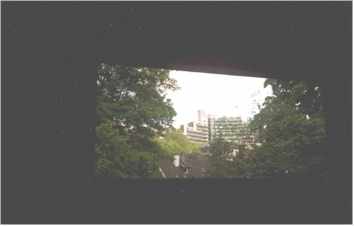 |
The photo shows the view of the university campus taken from the window of my studio apartment. As you can see, the university is located on top of a hill.
The quality of the teaching in German universities really was very high. My economics professors seemed highly authoritative and knowledgeable about their fields. It was in Germany that I got to apply my theoretical knowledge of economics in earnest. I even learned about the "economics of love"- how a relationship must be reciprocal to be beneficial. An economics professor explained this over a beer at the regular "Stammtisch"- once a week every week, exchange students got to meet their professors and each other at this gathering. A Stammtisch is a good idea- it provides a regular, scheduled legitimate approach opportunity and social gathering.
I eat well during my year in Germany, with hot meals available every weekday from the university canteen. Called the "Mensa", this canteen offered a novel food delivery system. Students queued up to pay (at heavily subsidized prices) for a food token. There were samples of the different meals in a display case for you to look at as you queued. There was usually a choice of a couple of main courses and a vegetarian choice. The food was delivered in little plastic dishes- so that you could combine a main course with a choice of side dishes. Having bought the tokens you wanted, you went down some stairs and selected your food from some revolving carousels. Behind the carousels, the food was being cooked in the kitchens. Once you had selected your purchases, you took them over to a counter and handed over your tokens. Having eaten your chosen food, you took your empty dishes back and put them onto another carousel that led- it is assumed- to the dish washing machines. I think this was quite an efficient mass production, quick-service food delivery system. I would however have liked to have had the opportunity to buy lots of tickets in advance rather than having to queue each day, and it would be more convenient not to have to pre-select food as this precluded impulse purchase at the conveyer belts!
I do recall a time when I had turned up at the Mensa just one of the ladies who sold the food tickets was shutting her booth. She refused to sell me the tickets that would have allowed me to eat, even though it was only around about closing time. This arbitrary inflexibility really annoyed me even then, although not half as much as it does when I see it these days. On another occasion, I asked for a menu option that contained fish- the ticket-selling lady knew that I did not eat fish and pointed this out to me- to the visible surprise of all the students in the queue behind me- who wondered how she knew! I had got to know her gradually on the basis of my daily purchase. Once again, it all depended on which person was on duty that day- at the end of the day, humanity matters more than anything else.
I remember standing in line to buy a meal token for the Mensa and thinking to myself that the German accent was really bland. Even the people who do the voice-overs on television and radio advertisements have uninteresting and unappealing voices. I do enjoy the German language a lot though, especially the way that one word often comprises several sub parts that together confer an overall meaning. For example, the German word "Lesitungsfaehigkeit" means efficiency and comprises three sub parts: "Leistung" which means performance, "faehig" which means capable and "keit" which means ability. Knowledge of one or more of the sub-parts is enough to allow understanding of the overall meaning of the word.
WORKING IN GERMANY
German universities were running on a system of two terms per year. During the three month long Semesterferien, I worked for a start up computer manufacturing company. The company was organized such that one director was responsible for both the accounting and personnel departments. I worked in this division, mostly in the personnel department where my office was located.
Until I started insisting upon working from home, I had never worked in such a comfortable working environment. Employees regularly received fresh flowers to brighten up their offices. I eat fresh filled rolls from the company canteen every morning for breakfast and then had a full hot meal for lunch. Most offices had a bowl of sweets for visitors to help themselves too. In short, I had never been so well looked after by a company! My office even came to be called "Buckingham Palace" because it was so spacious! For all I know, it retains that moniker to this day! This was a great employment regime if you can afford it!
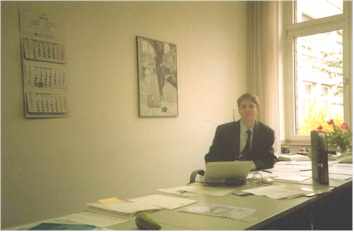 |
When a company operating in Germany expanded beyond 500 employees, it was a legal requirement for them to have elected employee representatives to participate in certain company decisions such as employment-related issues. Because I was in the personnel department, I was able to observe the way certain "employer friendly", non-unionized employees were selected as these representatives. A company meeting was held (again a legal requirement) and those employees interested in being on the company committee as employee representatives were asked to raise their hands. The head of personnel only then acknowledged those candidates who had been sounded out before the meeting!!! I met with these representatives after their "election", and they were the young fast track management candidates of the future. The way to get ahead in Germany was to raise your profile as a "constructive" employee representative rather than as a trade union member.
I have seen a lot of ugly concrete and glass buildings in Germany and some wonderful beautiful old towns and villages such as Baden-Baden and Heidelberg. A typical picturesque old town in Germany is shown in the photo below.
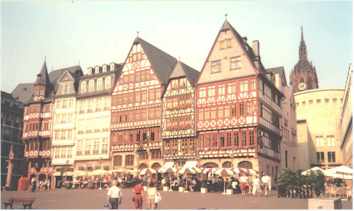 |
The old and the new contrast strongly in Germany- even more so than in the rest of Europe. I like German people- they have a tendency to be serious and dress either badly (jeans, jeans, jeans, yellow socks, mint green rucksacks) or strangely (hunting gear such as knickerbockers and small dogs were frequently on show in Dusseldorf), but tend to be thoughtful, outward looking, efficient and healthy.
UNORGANIZATION RATING
HUMANITY: 1.5. German people are generally pleasant once you get to know them and have a reason to work with them- colleagues and teachers and so on. Reticence towards strangers can be high though, and customer service enthusiasm lagging.
QUALITY OF LIFE: 1. Not a place for shopaholics- unless they are attuned to shopping at specific times and days.
SAFETY: 2. A relatively safe country- although drunks are commonplace at train stations- and neo-nazis occasionally too.
GOVERNMENT: 0.25. The German social market economy involves having a strong public sector. There were lots of regulations- as a visitor, I was expected to register at a foreign persons bureau. The social democratic government voted into power in 1998 did not help.
PROSPERITY: 0.5. Personal and corporate taxation levels were very high, but there was a high degree of tax avoidance.
TOTAL: 5.25 out of 10. Germany would be a much better place if they fully liberalized the shop opening hours and put customers first.
PORTUGAL
In the summer of 1998, I visited Portugal for the first time since my 1986 holiday in the Algarve. This time though, I was in Lisbon, the capital city, primarily to visit Expo 98, the world exposition that had just started. I was surprised to see in the world pavilion at Expo 98 how countries from all around the world were seemingly randomly assigned rooms- with countries that had been in conflict with one another placed next door to each other. This was a unique opportunity to see the whole world in one day- and catch a feel for what each country thinks its special at.
I had to wait 40 minutes at Lisbon airport to retrieve my luggage from baggage reclaim. The terminal building was newly constructed but this modern amenity was of little comfort to me as I waited impatiently for my luggage. There was no mobile phone network coverage in the terminal either which did not help my mood.
This wait was followed by a frenetic and stressful bullfight between my taxi and the other traffic on the way to the hotel (in keeping with other countries such as Belgium). I then endured a stressful hotel check-in experience (See below) and after all this was not feeling too good. All around me, I could see much construction and renovation work going on, akin to somewhere like Poland. It looked as though the vast majority of older buildings had been neglected for long periods. I imagine that the construction industry was a big employer in Portugal.
CONFLICT AT THE HOTEL TIVOLI LISBOA
I arrived at my hotel, the Hotel Tivoli Lisboa on the Av. Liberdade, at about three o’clock in the afternoon. The hotel had a five star rating, and used this prominently in its logo. The charge for a single room was about 200 US dollars per night.
Despite its five star rating, I was told that my room was not ready and would not be ready for half an hour. I asked the receptionist why I had to wait 30 minutes in a five star hotel when I had a reservation and it was three o’clock in the afternoon. I had my first meeting within an hour of my arrival and needed to change into my business suit. I put on quite a display of pacing around the hotel lobby and a room was found for me almost immediately.
I did have to wait whilst the hotel receptionists photocopied my passport. I could see that most passports had been retained in the hotel reception, but demanded my own back as I was not going to leave it with those incompetent people. It was a good job I did as I docked my passport at several meetings. It was common practice to hand in some form of identification such as a passport or identity card when you visit offices in many countries such as Portugal and France.
The next morning, I arose to a five a.m. wake-up call. I showered, planned my schedule, answered my email messages and so on. The hotel concierge helped me locate some of the buildings I had to visit that day (offices, universities etc.). He did get one building wrong- he was using an old street atlas to find a building on a newly built street.
The hotel served breakfast at seven o’clock and I was ready and waiting outside the breakfast room at seven sharp, as were several other people. Inside, waiters were still laying out the food on the central display. I went into the breakfast room whose doors were closed and was told to wait outside as they were not ready. A waiter then placed a seat against the double glass doors to hinder further entry. Not only did the hotel start breakfast at the late hour of 7 a.m., but they were not ready on time, and unwelcoming, if not rude, to their customers. In many hotels, restaurants open earlier for breakfast service, although days in Portugal did not really get going until at least 9.30 a.m. Breakfast was available from 6 a.m. through the hotel’s room service.
Sometime during the next night, the following letter was put under my room door. I have copied it exactly:
Dear Client
Welcome to Lisboa and Hotel Tivoli
We hereby inform you that the Unions declared for 24 hours a work stoppage beginning on 00h00 from today.
Over the last weeks, the Labor Unions have scheduled several actions like the one that we are facing on the Hotel business, but also in transportation’s and some of the governments departments.
The Management of Hotel Tivoli, will provide during this period the continues good service to our clients.
Although some of our services will be affected.
Hotel Services
Breakfast
Breakfast will be served in Restaurant Zodiaco and Sala Castelo Branco, one floor above the concierge, between 07h00 until 11h00.
We would like to suggest to all the clients occupying rooms on floor’s 1, 2 and 3, to take the breakfast on Sala Castelo Branco, mezzanine floor.
Lunch and Dinner
Buffet will be served in Restaurant Zodiaco.
Bar
Bar has is normal schedule and service.
Room-Service
During this period this service cannot be provided.
Mini-Bares
The lack of products will be replaced on the 30th.
Housekeeping and Roommates
Rooms will be cleaned on a normal basis. Unfortunately we cannot guarantee the night services as usually.
Laundry Service and Dry Cleaning
This service will be closed for this period.
In the lobby there will be newspapers and coffee-break service permanent, free of charge.
There will also be a Guest Client Desk between 07h00 until 22h00, and if you need any assistance please be so kind and dial number 802.
Thank you in advanced for your co-operation, and our apologies for any inconveniences this may cause and trust that you will find the services to our best.
Best Regards
The Management
Perhaps this strike accounted for some of the poor service I received during my stay at the hotel. But I think that the problem was individual and not institutional- I received good service from a few of the hotel staff such as a friendly waiter and a helpful receptionist when the card entry key for my room door would not work. If people are inclined to offer good service, they can bypass inflexible corporate procedures. For example, the district sales manager in Belgium was also able to overcome inflexible colleagues to serve a customer.
Good service is about people with a positive attitude offering great products and services through flexible processes. In the Hotel Tivoli Lisboa, neither the people nor the processes were right, and no amount of five star services could make my stay a pleasant one. My goodwill towards the hotel had been destroyed immediately upon my arrival, and nothing I subsequently saw or received could change that. The real question I keep asking myself is who gave the hotel its five star rating- the socialist government of Portugal or the communist government of Cuba?
UNORGANIZATION RATING
HUMANITY: 1.5. Some of the people I met in Portugal were friendly and some were not. Some were down to Earth and helpful and others were thoughtless and arbitrary.
QUALITY OF LIFE: 0.75. There was a lot of construction going on and the roads were particularly congested in Lisbon- due to the narrow streets. I am sure that the quality of life in the Algarve for example is much more convivial.
SAFETY: 1.75. Lisbon was a relatively safe place- although there were a lot of people hanging around on street corners.
GOVERNMENT: 0.5. Socialist neglect of buildings. Portugal is a former dictatorship so everything is relative I suppose.
PROSPERITY: 0.5. European Union development support. Higher than average taxation levels.
TOTAL: 5 out of 10. I would not like to live in Lisbon, but the Algarve would be nice!
REPUBLIC OF IRELAND
I spent a week in Dublin, the capital of the Republic of Ireland, in May 1997. This was quite a long stay for what was a business trip, which gave me the chance to explore the city.
DUBLIN
On arrival in Dublin, my taxi driver from the airport warned me about the main thoroughfare I was staying on and said that there were some unsafe places along that road. He told me stories about shop assistants being held up by drug addicts with blood-filled syringes. My hotel, the Gresham, was very old and was one of those hotels that cost a lot of money- about 150 Irish pounds per night (about 200 US dollars) for an old room. The hotel had lots of photographs of old movie stars and so on who had stayed there decades ago- it was trading on its past. Like the hotel, the main thoroughfare just looked as though it had been neglected for too long- the streets were covered in chewing gum and pigeon mess and the whole area was very gray. There were lots of people- young and old- hanging around on the streets. I immediately felt a sense of uneasiness about my safety that I rarely feel anywhere else in Europe. Part of this was my impressions of the streets, and part was of course because the taxi driver had warned me.
Basically in Dublin, there is a road with lots of old shops and a few hotels on it, followed by a series of interchanges and pedestrian crossings. You then reach the area near to Trinity College- in keeping with many old university colleges- this has great architecture. After passing through some gates and arches, you enter a square with lots of old buildings and some grass in the center. Leaving the college campus, you cross a couple of roads and enter the pedestrianized main shopping street, which was very tidy and modern and smart, with obviously new and renovated buildings.
I visited the Guinness brewery whilst in Dublin. There was a museum with sampling, explanations of the brewery process and those other kinds of exhibits that you would expect- just like the Carlsberg brewery in Copenhagen. The Guinness buildings were functional and purposeful- and therefore had much more in keeping with Stella Artois in Belgium than Carlsberg in Denmark with its ornate decoration.
I went back to Dublin nearly two years later in January 1999 for a couple of days. Observations were:
Some Americanization was visible with shopping malls, multiplex cinemas and drive-thru restaurants lining the route between Dublin airport and city center.
Dublin city center was very hectic in the center at all times of the day and night. Traffic and pedestrians fought for the right of way across the road. Walking was punctuated by waiting for traffic lights to change and then mad rushes to cross the street. Stop and go was the way to make any progress.
I stayed in Jury's Customer House Inn ++353 1 607 5000) that was quite new and very inexpensive given the facilities it provided. I asked the receptionist why the rooms were so inexpensive and yet feature rich and she explained that it was because of the classification as an "Inn". Apparently, if you close the bar at 1.30 in the morning, you are not a hotel, since some customers complain in Dublin about this!!! They must take their drinking seriously over there (name a place that does not). An arbitrary label causes this arbitrary distortion.
The Inn was located next to the Harbourmaster Place redevelopment area. This is a business area with a guarded entrance and street signs saying that the management reserves the right to refuse entry. It contained a lot of offices- in particular for banks, but few retail outlets. The area combined flats with balconies overlooking the harbor and lots of glass fronted offices. Apparently the whole are used to be really run down, but these days the new headquarters of Citibank is being built on top of the razed slum houses. There were apparently still some less prosperous areas just on the edge of the redevelopment, part of the reason for the "supervised patrolled access probably.
DROGHEDA
I also visited Drogheda during my visit to Ireland. I estimate this town to be about an hour by train away from Dublin. Seeing a small country town confers perspective against the large, fast, dirty city. I am sure that Ireland is a country that is centered more on its towns than its cities. Drogheda is the more rural and scenic part of Ireland with a small town center and lots of greenery.
I was in town to visit the Coca-Cola concentrate plant- one of the few places in Europe where the syrup that goes into Coca-Cola is mixed. There is not even a Coca-Cola sign to advertise its presence due I think to security issues- protecting the secret formula!
The intersection linking the railway station with the town center and road to the Coca-Cola facility was interesting because it had just been Americanized with a drive-thru McDonalds. This was a new facility with a new side road and some new houses or offices were being built around that area.
UNORGANIZATION RATING
HUMANITY: 2. I did not personally benefit from the famous Irish hospitality, but then I did not spend much time in pubs. People were friendly, but not excessively so.
QUALITY OF LIFE: 1.5. There was plenty of night life- pubs, clubs and restaurants- in Dublin and beyond.
SAFETY: 0.5. For a European city, Dublin was relatively unsafe. This was because of visiting stag nights- men celebrating before marriage, plus local drug addicts and drunks.
GOVERNMENT: 0.5. The government was an average one.
PROSPERITY: 0.5. Ireland does receive its fair share of European Union development funds.
TOTAL: 5 out of 10. I prefer rural Ireland- Drogheda and the like- to cities such as Dublin. It is the difference between green and gray.
ENGLAND
I have always lived in England and as such, I belong there and I understand it and it is easy for me to live and work there.
NEWBURY
Since the age of 11, I have lived in a town in the South of England called Newbury. Newbury is a relatively prosperous town- it is often referred to as having the lowest level of unemployment in Europe and so on and so forth. It is a market town- built up around an open-air market selling fruit and vegetables, meat and so on. The market still runs on Thursdays and Saturdays. Newbury was a good place to bring up a family since some of the schools in the area (public and private sector run) were very good indeed.
Everyone and everything I need for everyday life is conveniently located in Newbury. My parents run a business there, I studied there, worked for a company who are based there and have teleworked and worked from there ever since. I know a lot of people in Newbury- people I worked with, went to school with, played soccer with, my family is there. The people I buy stamps and magazines and business cards and so on from all know me. My newsagent knows what papers I have and gets them for me, they treat me well because I am a regular known customer, they don’t ask me if I have a loyalty card in Tesco because they have asked me before and know that I haven’t. I know where everything is and the town is relatively safe so I don’t have to worry or think too much. It is easy to get to a lot of places from Newbury- it is only an hour from London or Heathrow airport, so I get to think in relative quiet whilst not being too far away from the activity. Unfortunately, Newbury was a relatively homogenous town with little diversity in nationality- however, this situation noticeably improved even during the course of 1998.
People often ask me why I stay in Newbury rather than move to London or somewhere else. I always reply that I believe that in this day and age, it does not matter where you are located because work is a location-independent activity. As such, you may as well be located somewhere that you are familiar and comfortable with.
LONDON
I have been traveling up to London with increasing regularity for working and visiting friends and shopping. I like London, but I would not want to live there. London has amazing history and architecture- it has lots of different styles and ages of buildings in the same street- there is constantly something different to see from the very old to the very new to everything in between.
London has many suburbs like Battersea and Stoke Newington and Balham where you pay a lot of money for a very small property and have to travel to get anywhere anyway- by bus or underground rail (tube) or foot or something. You may know lots of people who live in London, but getting from suburb to suburb to see them takes up a lot of time.
The people of London are very diverse too- people look different and are off doing different things. There are very rich people and very poor and the majority in-between. You have the lively diverse places where you see this rich mix of people such as Soho. You can arrive at Oxford Circus underground station and work along Oxford Street where the shoppers and tourists and shopping tourists congregate- its just a modern shopping street with Selfridges department store up at one end close to Bond Street and Carnaby Street and some other places. You can walk away from Selfridges and cut down Dean Street into Soho, the media and advertising and sex and gay district. From there you can go to Charring Cross Road where all the book stores are and then head into Covent Garden, where the boutique specialty and fashion and other shops are. You can also take the tourist route and go from Nelson’s Column to Buckingham Palace and then up The Strand back to Covent Garden.
You cannot put your finger on London- its people and its buildings keep changing. The central sights and places are all quite closely packed together when you can get a sense of perspective. There is no set agenda. Restaurants and bars and coffee shops and caf's and newspaper shops are everywhere, as is the traffic. These things always stay the same. People, cars and sights and things are always coming at you. Space is always limited- buildings are being renovated and car parking spaces are small and lots of people around. You get sucked into the hustle and bustle of London street scenes with masses of shoppers and litter and hawkers and street vendors necessitating either being swept along in the crowd or frantic ducking and diving in an effort to make faster progress. London is an exhausting city because of its very diversity and activity.
BIRMINGHAM
Apart from Newbury, the only place that I have lived in England during my adult life is Birmingham. I lived in England’s second largest city whilst studying Commerce at the University of Birmingham for my undergraduate degree. I spent three happy years in the city.
When English people think of Birmingham, they think of an industrial city that is not very picturesque. They may also be familiar with the old city center from the 1960s with its rotunda and underground shopping center (Both of which have since been demolished). They would also be familiar with the famous- and much derided- "Brummie" accent- the distinctive way that people from the Midlands speak. In sum, Birmingham did not generally have all that positive a reputation.
Thinking back to my time in Birmingham however, I have an overwhelmingly positive impression of the city. The University of Birmingham is not located in the city center (unlike Aston University), it is in Edgbaston, a suburb a couple of miles outside. Edgbaston is a very green and affluent area of Birmingham, with lots of large houses, many of which neighbored cheaper public housing and tower blocks. I lodged for two years in just such a road- in Carpenter Road- one of the best postcodes in the area- yet I was staying in a council property. I love the Birmingham University campus- it is great to have everything- learning and living facilities- conveniently located within walking distance.
I used to walk from Edgbaston into the city center nearly every day- to do some shopping and for the fresh air. Once again, on such a walk, you see large properties, and as you get closer to town, tower blocks. As befits such a large city, Birmingham city center is great for shopping. Birmingham had been undergoing a program of regeneration- with many new shopping and arts facilities.
During my three years at university, I traveled around and see quite a lot of the suburbs. I spent a lot of time in the areas where a lot of students live- Selly Oak, Balsall Heath and Mosely. The later two are very cosmopolitan areas where a tremendously diverse population resides- from families to students to prostitutes.
I think of Birmingham as a great city where there is a fantastic university campus and suburbs and the center interspersed with many nice and ugly areas. The people were always down to Earth and pleasant.
Often when I am traveling on a train across England and see its wonderful countryside and geography, I feel a love for my home country. This is then punctured by the thought of the zealous interventionists in the UK government who historically have dominated the country. You cannot pass the town of Bath Spa on a sunny day without being filled with awe and joy at the architecture. There is a stickiness about England that lies in direct contrast to the peelability of America. In England, so many layers of activity have built up over hundreds of centuries that it would be impossible to reconstruct the authenticity of its permanence. Everything was new once, but over time, the weather, users and inhabitants have beaten against them. The beautiful, mundane and downright ugly are intermingled so entirely as to be inseparable. This was followed by that was followed by the other- with only water to connect them. Later day planning can thankfully never regulate the tapestry of this past development. The location of farmhouses and other buildings and hedges and paths and so on seems to be entirely random, yet whilst it may not have reason, it certainly has rhyme. This contrasts with the block by block straightness of America. Everything seems so impermanent in the US- with hotels made from reinforced wood- you feel as though one hurricane would blow it all away. Over there, it is all about chasing current demand- doing things as soon as possible.
UNORGANIZATION RATING
HUMANITY: 2. England contains a lot of nice friendly people who are happy to help strangers. People are not necessarily proactively open- but do tend to help when asked and the old people especially will speak to strangers when standing in queues or in shops.
QUALITY OF LIFE: 1. Millions of people commute to work in England- even early in the morning, you see lots of cars on the roads and commuters in the trains making journeys of dozens of miles to get to work.
SAFETY: 1.75. England is a relatively safe place. Groups of drunken youths can appear after dark, but their bark is often worse than their bite.
GOVERNMENT: 0.25. Britain has been a constitutional monarchy for a long, long time. People don’t even question whether the government should exist and is useful- they assume it is. Governments of all stripes encroach on the freedom and livelihood of individual citizens. (I really do not like the new Labour UK government that was voted into power in May 1997. See also www.unorgan.com/uk.htm for "Cool Britannia or Nightblair on Downing Street? A review of the "New" Labour government’s first year in government in Britain").
PROSPERITY: 0.25. It is not unusual for half of an individual’s income to be taken by the British government. Personal, sales, local council and business rates are all set at rates that far exceed the benefit that this expenditure brings. It is difficult to see what return taxpayers get- and certainly to classify that as an adequate return. I detest the amount of tax that I pay and the little good the government does for me or anyone else.
TOTAL: 5.25 out of 10. England is not the worst place in the world to live- it is quite a good base for operations- you would be well advised to travel around though, since the people can be negative and skeptical about any entrepreneurial activity.
Scandinavia
I like all the Scandinavian cites because they are small enough to walk from one end to the other with ease, and you are never therefore far from your next appointment. The cites are nice and the people too. All of the cities are very safe. Equality and respect of women is widespread. The climates can be cold. Quality of living is good too- with pedestrianized shopping streets and strong public transport systems. Of course, Scandinavia suffers a lot, like many places, from its political systems. The government presence and influence is great here- with lots of taxation and regulation just below the surface that the visitor rarely has to see.
NORWAY
I have visited Oslo on a couple of occasions because unorg has some strong supporters in Norway who invited me to give presentations to companies and conferences. I also took a train to Bergen for a meeting (see below). I think Norway is a great place. I always stay in Westside Hotel which is on Eilert Sundsgt in Oslo (TEL +47 33 56 87 70, FAX +47 22 56 63 20). This is an excellent family run hotel with very clean rooms and friendly staff. The Westside Hotel is located about a kilometer outside of Oslo city center (behind the royal palace) in an area called Solli that has a lot of shops and activity. The view of residential Solli taken from a window in the hotel is shown in the photo below.
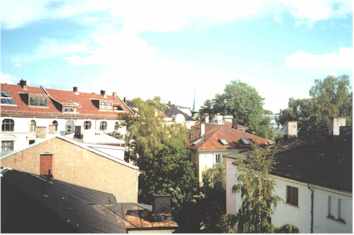 |
To get to the city center from Solli, you can walk down a hill through a park and past the royal palace where there are always armed soldiers marching in a strange and energetic manner whatever time of the day you pass. I remember walking past the royal palace very early on one bitterly cold Oslo morning and seeing this young man passionately carrying out some foot maneuvers even though there was no-one around. I remember thinking about the follies of national history, government and royalty, and feeling a lot of sorrow for that young man wasting his life. He had probably been doing that all night, and for what and whom?
From the palace, you walk down a straight road that is closed to the public and keep walking straight ahead to get to the main high street of shops. In fact, you can walk in a straight line from the palace to the main railway station- and all of the sights and shops are within easy reach of that thoroughfare. This is why it is so easy to navigate around Oslo. When you get to the main train station, you can take a train across Norway to Bergen, as I once did.
THE FOLLIES OF A TRAIN JOURNEY ACROSS NORWAY
In September 1997, I purchased a train ticket from Oslo to Bergen. I paid 520 Norwegian Krona for a single ticket: about US$75. I went into the half empty second class carriage and sat down in an empty seat, settled down with my luggage and so on. The uniformed official came along soon after the train had departed from Oslo and told me that I was sitting in the wrong seat and to move. Apparently, when you book a ticket, you were automatically reserved a seat in a certain carriage which was printed (in Norwegian only) on the ticket.
A few things: Rule 1, the customer is always right and Rule 2, if the customer is wrong, see rule 1. No one tells me or has the right to tell me where to sit: this is micro-intervention in my behavior which severely limits my freedom down to just one seat out of the hundreds of possible choices. What right has anyone to define exactly where I am going to sit and prevent me from sitting anywhere else? The Norwegian railway company, the NSB, was government-owned but even so, this should not mean that a customer with a valid ticket should be told where to sit in a supposedly free society.
I did eventually move myself and my belongings, but only after arguing with the official and calling her a socialist. When I went back to have a look at my original choice of seat later on during the journey, the train officers had placed a young uniformed army constrict in my seat!!!!!!!!!!!!!!!!! A couple of state employees helping each other out- how nice- that poor young man, who in keeping with most European countries was probably forcibly conscripted to waste a prime year or two of his life.
There were a lot of train officers ensuring compliance. These people were there to watch customers and not to serve them. I have never seen such a segregated organized environment, with its toilets for staff only (and parking areas in the train station car parks: they must have a strong trade union). I could not believe it when I found out that first class passengers were issued with swipe cards (like you get in hotels) because the doors between the standard and first class carriages were LOCKED!! That should keep the riffraff out of the first class areas!!!!!! Even worse, the first class passengers could not get the cards to work and the doors to open- I had to show a couple of people to help them return to the "civility" of the first class carriages.
These employees (in polyester suits: you know the ones that rail employees seem to get in every country (apart from Belgium, where uniforms are smart) were not simply checking tickets but looking at seat numbers, moving people around, regulating luggage positioning. When I got to the "right" carriage, a different official checked my seat and was visibly and audibly surprised to find that I had found the right location!
The officials each carried a detailed paper report- checking seats was a major administrative undertaking. I used the example of the NSB in many of my subsequent presentations to Norwegian companies and was told that little technology was used. The seat allocations were printed off prior to departure, but nobody knew the level of sales subsequently at subsequent stations. There was no handheld technology giving an up-to-date picture of sales.
And even if such technology was used, there is no reason why each rail station needs to know anymore information than how many tickets of which class are still available so that they do not overbook and sell tickets to more people than there are places. That is all: no individual seat allocation can ever be justified and morally defended.
Some people said to me that it is better to know that you have a particular seat and which seat it is in advance of your journey. However, it is sufficient for me to know that when I turn up for my train I have a space there- it does not matter too much which space it is, especially if I can freely choose where I sit.
Organized systems reward compliance with arbitrary rules. You will be left alone if you do what you are told. These outmoded systems hassle anyone who is different or difficult or independent in a world where everyone is becoming and should become different. Half of the passengers taking the six hour train journey across Norway were tourists who almost certainly did not understand the system.
The Oslo to Bergen line is a wonderful trip with great scenery and wondrous geography. These were modern trains with comfortable padded seats. Yet have you noticed how uncomfortable you can feel in places where there is a pleasant interior but suspicious people- like company offices for example.
I suspect that this over-regulated, over-organized, over-structured, interventionist, elitist, bureaucratic, officious environment of the Norwegian State Railway was one of the worst excesses remaining from the old days of communism and planning. It was an extreme that I rarely come across.
I flew back to Oslo a couple of days later by an airline called Braathens Safe. What a terrible first name for an airline (try pronouncing it) but nonetheless they had managed to quickly capture 50% of the Norwegian domestic air market. I suspect that the hardest part was not actually getting that share, but getting into the market in the first place to compete with the state-owned dominant Scandinavian airline SAS, which was renowned for its very high prices. Braathens had no seat policy: you could sit in any free seat. Each passenger chose where they sat. I could not help but smile- this was an airline I could feel comfortable with in the unorganized world!
UNORGANIZATION RATING
HUMANITY: 1.5. You generally find that people in Norway are friendly and polite. People like the train ticket inspector are the exception rather than the rule.
QUALITY OF LIFE: 1.25. Plenty of nice restaurants can be found. People work reasonably short hours and probably don’t have to commute too far to work in a relatively small city where public transport was widely available.
SAFETY: 2. Oslo was a very safe city- I did not feel unsafe walking the streets early in the morning or late at night.
GOVERNMENT: 0.25. None of the political parties in Norway have a positive mandate- they are pro-European and anti-immigrant. None are anti-European integration and pro-immigrant.
PROSPERITY: 0.25. Government in Norway takes a large share of private income and accounts for a large proportion of total economic activity.
TOTAL: 5.25. Norway was a great country with good looking and friendly people. The cities are small enough to walk around. As usual, the heavy hand of government deadens the pleasure of the place.
DENMARK
AROUND COPENHAGEN
In March 1998, I made my first visit to Denmark, staying for three days in Copenhagen, the capital city.
Copenhagen was a genuinely diverse place- there were many people from many different countries. This was true diversity in that there were quite a high proportion of non-white people, a large number of different ethnic groups were represented, everyone spoke the Danish language, and people of different nationalities mixed together- I routinely saw different colored people talking and walking together. This had to be one of the most precious features of Copenhagen. A huge number of newspapers from different countries were available at the central station.
The attitudes towards nudity seemed relaxed- I was wandering around a shopping mall in a suburb of Copenhagen called Glostrup when I came across a display in the center isle of paintings of nude women and a few men. Children and many of the adults just walked past without a glance.
A visit to the Carlsberg brewery near Copenhagen is well worthwhile. The brewery took up a huge area of land and was more like a village in its own right. The founder of the brewery wanted the buildings to serve both practical and artistic purposes and therefore many of the building exteriors featured ornate statues and carvings. The brewery was known locally as a cathedral. Unfortunately for the company, from the 1880s to the second world war, Carlsberg used the nazi swastika symbol as its logo- hence many of the oldest exhibits in the company museum featured this symbol.
One of the most modern suburbs of Copenhagen I found was Hellerup where the old Tuborg brewery was located (Tuborg and Carlsberg merged in 1970). The old brewery had been redeveloped and many new office buildings had been built in its place. Many parts of the brewery itself such as the storage areas had become offices for a wide range of different firms. This redevelopment mirrors those globally such as the Rover car plant in Cowley, Oxford which became a through road and hypermarkets and biotechnology office parks and the old British Steel plant area in Stoke-On-Trent in the UK which became lots of out-of-town shopping malls.
I toured Christiana, located a couple of kilometers outside of Copenhagen city center. This was once a military camp that was taken over by squatters who set their own laws. The Danish government legitimized it by calling it an experiment in communal living. No cars were allowed, but then they would have difficulty navigating the narrow cobbled pathways. No hard drugs were allowed, with a symbol on the wall showing a fist smashing a needle, but soft drugs were freely available and openly sold and smoked by market stallholders. Dogs roamed freely, and I did not see a single women out and about.
I stayed in The Grand Hotel, which was very close to the central railway station in Copenhagen. It was a reasonable hotel- you got a meal ticket for a decent dinner in the hotel restaurant or a handful of others around Copenhagen. I did have one difficulty- someone who cleaned my room threw away the plastic carrier bag with my toiletries in. I had left it on the bathroom floor- but then again, it was full and should not have been thrown out. Upon reporting it to the hotel reception, they told me that I should arrange to speak to the maid and find out if she knew what she had done with it. I do not mind talking to the maid, but I object to a hotel creating a problem and then expecting me to solve it myself! As in Belgium, in Copenhagen, customers were routinely expected to queue to make purchases- this was the case almost everywhere for anything you bought.
The Danish people that I met were very helpful and laid-back. On one occasion, a Carlsberg manager heard me ask at reception where the museum was located and offered me a lift in his car. On another, a bus driver drove me to my destination, even though it was his lunch hour and not on any bus route. The bus became my taxi! When I could not find my way to a certain office, the employees in another company made detailed inquiries and pointed me in the right direction.
Working hours seemed quite relaxed. Offices closed quite early at 4.30 in the afternoon. School children did not wear uniforms and seemed to be out and about wandering the shopping streets at all hours of the day. In the UK at least, you don’t see young school age children during school hours- they are on the school premises.
All in all, I liked what I saw of Denmark- yes, it was raining but then again that’s Europe in March for you. The positive aspects included the diversity and helpfulness of people, but there were also negative aspects such as the poor customer service and the following example of excessive office rules:
A REAL EXAMPLE OF EXCESSIVE OFFICE REGULATIONS IN DENMARK
During my first visit to Denmark in March 1998, I came across the following list of office rules on the wall of a company’s offices. This is a translation of the rules in force in one of the largest companies in Denmark.
OFFICE REGULATIONS
…IT MAKES LIFE A LITTLE HAPPIER FOR YOUR COLLEAGUES
The following rules must be followed- if you don’t, there will be collective bullying or you will be given manual labor to do.
- Meeting rooms MUST be cleaned after use (including audiovisual equipment)
- Empty bottles MUST be put into bottle crates
- Used glass/ cups etc. MUST be returned to the kitchen, cleaned and put into a dishwasher
- Office furniture MUST NOT be left in empty rooms or in corridors but shall only be removed after you have talked to {NAME}. Garbage, boxes etc. MUST BE placed side by side in the containers in the cellar
- You MUST tidy up around the photocopiers and fax machines after use
- Faxes MUST be distributed around the offices
- Lights MUST be turned off/ windows must be closed- even if it is not your own office
- PCs MUST be switched off
- The last man/ women MUST ensure that the office door is locked
- NO-ONE is allowed to remove anything from anyone else’s offices, drawers or office cabinets without permission/ or without leaving a message
All these rules about mere things- machines, furniture, drinking utensils- get elevated above the people they are supposed to assist. Employees MUST do trivial things. You will see immediately how the existence of these static, arbitrary, prescriptive office rules is a fundamental justification for "downstructuring"- removing static structures aimed at controlling other people in the organization.
UNORGANIZATION RATING
HUMANITY: 2. These office regulations show the sharp side of the Danish psyche. However, the helpfulness and openness to diversity more than compensated for this and elevates Denmark’s overall unorganization rating.
QUALITY OF LIFE: 1. Copenhagen had plenty of restaurants and caf's and shops- with pedestrianized shopping areas.
SAFETY: 2. As usual with Scandinavian cities, Denmark was a very safe place.
GOVERNMENT: 0.25. As usual with Scandinavian countries, Denmark’s government dominates the economy and society.
PROSPERITY: 0.25. An egalitarian country in which income differentials between the richest and poorest are kept small, and in which being different and conspicuous in richness was frowned upon.
TOTAL: 5.5. Denmark scores relatively highly because of the diversity of its people and safety of the country.
FINLAND
I spent a couple of days in Helsinki, the capital of Finland, in the late summer of 1998. Helsinki is a harbor city- with lots of water and moored boats in the center. Many people must have boats moored around the many lakes, and there was a lot of green space where people can walk and cycle around.
Finland is a very technologically advanced country- the taxis print you a detailed receipt saying which street you went from and where you went to. You can pay for taxis by credit card. The use of mobile phones is even more widespread there than it is in other Scandinavian and European countries. As I was visiting, the percentage of people that had mobile phones exceeded 50%- in other words, one out of every two people in Finland owned a mobile phone. This was a world leading percentage.
Certainly, a major contributor to this achievement is the fact that Nokia, then the world leading designer and manufacturer of mobile phones and mobile network infrastructure, was located in Finland (in the Espoo area, see below). Nokia dominated the Helsinki stock exchange as by far the largest stock there. The company even had its own postal district called Nokia for postal correspondence linked to its own large headquarters in the Espoo area, which had a glass exterior with some special coatings and layers to prevent eavesdropping by radio equipment!
ESPOO
What I liked best about my visit to Helsinki was the suburb called Espoo located a couple of kilometers outside of the city center. Espoo is great because it is an integrated environment. There is a pedestrianized street which combines offices with flats where people live with shops with schools and play areas all in harmony with each other as part of the same street and community and all within easy walking distance of each other. I like these kinds of environments where everything is readily accessible and you do not have to get into a car to get to where you are going. Everything you need for everyday life is right there.
As with Leuven in Belgium and Solli in Norway, Espoo immediately appealed to me and I knew that I could be comfortable there. If I was living in Helsinki, I would choose Espoo, Oslo: Solli and Brussels: Leuven.
UNORGANIZATION RATING
HUMANITY: 2. I did not come across anyone who was rude or unhelpful towards me in my short stay in Helsinki.
QUALITY OF LIFE: 1.5. Espoo with its integrated living environment in particular improves Finland’s score for quality of life.
SAFETY: 2. This Scandinavian country was relatively safe.
GOVERNMENT: 0.25. In keeping with Scandinavia, Finland had an interventionist government.
PROSPERITY: 0.25. Government took a lot of income from people to finance its busyness.
TOTAL: 6 out of 10. Finland scores highly due to the availability of technology, high education levels, convivial city center and polite and helpful people.
SWEDEN
I visited Sweden in the late summer of 1998, spending all of my short time there in the Stockholm area. I did travel out to a place called Hannige, a distant suburb of Stockholm that is maybe 25 kilometers away. Coca-Cola had just officially opened a huge bottling, distribution and administration complex in that suburb- centralizing and closing their other Stockholm facilities.
There was such a lack of hotel availability on that night that I was almost forced to spend a night sharing a room with some other people on a boat moored in the Stockholm harbor. In keeping with other Scandinavian cities, in particular Helsinki, Stockholm has a large lake area in its center. A taxi driver who was taking me to that boat knew someone who ran a hotel though and I was therefore able to change my accommodation arrangements.
COMPANY CANTEENS
I had a couple of meetings in Stockholm and in both cases, I sat down in the company cafeteria and had some or all of the meeting there. This seems to be a popular way of having an introductory chat throughout Europe- this kind of meeting was held everywhere from the UK to Belgium to Sweden. It is useful to have a communal place that is not linked to any one particular department, where internal and external meetings can take place, where refreshments and usually food are available and where colleagues can be seen and spoken with. This reminds people that they belong to a wider company- as it is easy to get lost in departmental objectives and thinking. By seeing other people from other departments, a wider perspective can be learned. I really like the caf' style environment where people come and go and pause and say a few hellos- it really complements the office/ cube type environment and offers a less formal and more interactive atmosphere and environment.
I liked the people and places I saw in Stockholm. I did not have time to come across anything that really annoyed me- of course, I am not paying the high levels of taxes or using any public sector infrastructure or "services" as a short stay tourist.
UNORGANIZATION RATING
HUMANITY: 1.5. No-one in Stockholm was unkind or unhelpful to me. No-one was overly helpful either though.
QUALITY OF LIFE: 1. Stockholm had plenty of restaurants and museums and other entertainment for people.
SAFETY: 2. Scandinavian safety once again!
GOVERNMENT: 0.25. Scandinavian heavy-handedness once again.
PROSPERITY: 0.25. In Sweden, relatively high taxation levels that can easily consume two-thirds of private income.
TOTAL: 5 out of 10. There are far worse places to live than Sweden. Nice people, nice place. But big government.
Eastern Europe
HUNGARY
HUNGRY FOR MONEY IN HUNGARY
When there was an iron curtain dividing the soviet block from western Europe, the flavor of communism practiced in Hungary was known as "goulash communism" because a few other ingredients apart from the state were mixed in. So I was interested to visit Budapest, Hungary’s capital, in June 1998, to see for myself how the first decade of the market economy had gone. I was taken aback to find a statue of Karl Marx inside the Budapest University of Economic Sciences- the leading business school was remembering a disproven and discredited theorist.
An undercurrent of a hunger for money was implicit but perceptible throughout my short visit to Hungary. Not just once, but on three occasions, I was swindled by taxi drivers. Taking a taxi in Budapest was a stressful experience- you either hired one at a westernized hotel and paid a lot as someone who could afford the high rates charged, or you hailed one on the street corner and paid a lot to a driver looking to exploit foreigners.
On one occasion, I was driven somewhere on a bank holiday when the driver must have known that the offices were closed that day along with everything else. On another occasion, I caught a cab from the Budapest Opera House back to my hotel, the Kempinski, and the driver set the minimum charge on the meter to 2000 Florins- this was about 20 US dollars for a ride of a few hundred meters. (I just could not locate the place myself or find anyone who knew where it was and could simultaneously speak English). I would regulate the taxis using the market not the state- anti-social taxi drivers should be banished by other drivers for lowering the reputation of all taxis.
I think that the fact I was saying at the Kempinski was part of the problem. The hotel has a reputation (undeserved I think- the hotel was six years old, and the doors and mini-bars were starting to malfunction) of being the best hotel in Budapest. I asked the hotel concierge to locate an address for me, then I had to go over it all again with the taxi driver. I asked a porter for help and he told me I needed the person with the hat- no cross training as usual: every employee has a place and there is but one place for everyone. The mere mention of the Kempinski was enough to light the dollar signs in the eyes of the taxi drivers.
I asked the driver of one of the cabs that I caught from the Kempinski whether he was continuously assigned to the hotel. He said yes, and I expressed the opinion that this was probably a more lucrative position than that of the taxis serving local people. But he expressed dissatisfaction, saying that there were fewer guests at the hotel these days. He thought that the reason was that the government was in transition from the socialist party to a new younger people’s party and its new 35-year-old president. The taxi driver thought that it was not that the outgoing socialist party was following the wrong (market-oriented) policies, they were just pursuing them too slowly and the people wanted quicker progress.
And it was not just taxi drivers who were on the look out for fast buck. Street vendors of products such as ice-creams and newspapers did the same. They gave you the incorrect change (too little not too much naturally!), and if you accepted it and looked back at them, they were acting oblivious to it with blank looks on their faces. These people were perfectly polite on the surface, yet doing all they could to con hapless foreigners underneath.
Poverty was much more tangible to me in Hungary than it was at that same time in other former communist countries such as Poland. You were approached by more beggars on the streets of Budapest than you were in Warsaw- many with leaflets, and none of whom I could understand. I even had the supreme displeasure of seeing an old homeless women pull up her skirt and go to toilet in a gutter in a underpass of a busy underground train station, oblivious to the crowds around her, and most of them oblivious to her too.
There is nothing wrong with Budapest visually- you wander around and see an unspoiled city replete with great architecture and well stocked shops. It was the people interface that was lacking- at least between Hungarian people and foreigners. And the people interface is the heart and soul of all civilized civilizations- without it, all you have is a superficial consumerist society. That’s why unorganization calls for technological capitalism and not just capitalism- because the ends of communism were not wrong, only the means were.
And so I am left with an unpleasant taste in my mouth about Hungary- it is just uncomfortable to be constantly protecting yourself against being ripped off. It is not that the Polish people have not made progress and come a long way in the past decade, it is more that some of the problems of uneven wealth distribution are more visible there, to me at least. Many western goods are available- everyone has a retail presence from Formula One, to Boss, to Champion sportswear, to Nike, adidas and so on. But these clothes are not of course affordable for most. It is not that I would not go back to Budapest if invited, just that I would not relish a return visit.
Hungary is hungry for money, but it needs to create more sustainable ways of earning it. It needs to offer its foreign visitors and investors added value, rather than trying to take as much as it can from then whilst giving them as little as possible in return. Only by adding value will the visitors become investors.
UNORGANIZATION RATING
HUMANITY: 0. In Belgium, people are simply rude and unresponsive. In Hungary, they are after your money.
QUALITY OF LIFE: 1. There is some nice architecture and renovated and pedestrianized shopping streets in Budapest.
SAFETY: 1. You do read of bombings in Budapest and get followed down the streets by beggars. Not the safest place in the world, but generally safe to walk the streets.
GOVERNMENT: 0.25. Governments change faster than progress is made.
PROSPERITY: 0.25. Lots of visible poverty.
TOTAL: 2.5 out of 10. Hungary scores the lowest unorganization rating of any country visited so far.
CZECH REPUBLIC
AROUND PRAGUE
I first visited a friend over in Prague over the new year in 1995-6. I remember with absolute clarity how cold it was at that time of year- it was so cold that when you went out, the feeling of cold dominated what you were doing and was nearly always uppermost on your mind.
As with so many other European cities, Prague has an old town and a new town. The old town is a large open picturesque market square with its famous clock that opens to reveal some mechanical figures periodically. The market square leads to the famous bridge with statues on it (and lots of street vendors selling souvenirs).
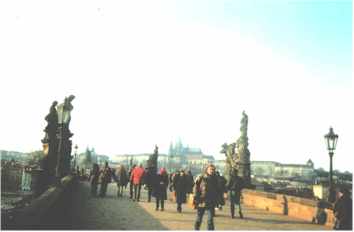 |
There are lots of nice bars and caf's and restaurants in the area. Shops selling Bohemian crystal, a specialty, are all over the place. Over the bridge, there is a hill with some castles and other buildings on it- I remember visiting a toy museum in one of them! The young people seemed to be letting off a lot of fire crackers to see in the new year and this meant that it was rather dangerous walking down the narrow people-filled side streets.
I was staying out in the suburbs in an old flat with very high ceilings that was always hot- it seemed as if the central heating could not be controlled, giving a real contrast between inside and outside! This was a typical suburb- lots of living accommodation plus a church and some supermarkets and butchers and restaurants. It was possible to have some goulash stew and some local beer for next to no money at all.
I have been back to Prague a couple of times since then for business and stayed in the darker, more modern outskirts of the center, visiting a great restaurant and bar that was aimed at overseas visitors to Prague. I have always found Prague itself to have poor weather, but have always been with friends and really enjoyed myself.
UNORGANIZATION RATING
HUMANITY: 1.5. Local people are reasonably friendly- not proactively so, but respond well to inquiries and requests. A local shop-owning couple was happy to offer me a Coca-Cola glass and then another one when it broke.
QUALITY OF LIFE: 0.75. It can get very, very cold in Prague during the winter. I had to walk a long way to get chocolate cake there- I eat in a restaurant and had to go to the market place to get desert! The architecture is lovely though and the beer and food plentiful and cheap and good.
SAFETY: 1.5. Prague is safe for an Eastern European city.
GOVERNMENT: 0.5. Post communist government have worked hard and made progress, but it has slowed recently.
PROSPERITY: 0.5. Prague is a reasonably prosperous place.
TOTAL: 4.75 out of 10 for the Czech Republic.
SLOVAKIA
On the plane to Slovakia for the first time, I read the "Central European Business Weekly" for the first time. I was quite worried to read a very strong editorial condemning the Slovak government in general and its prime minister in particular. Up until then, I had heard only that Slovakia was resisting some of the steps thought necessary for a market-oriented economy.
I arrived in Bratislava at about seven in the evening and came across no particular problems- other than the fact that I had a Visa card but the currency control desk only accepted Mastercard. The airport police on duty were helpful, pointing me in the direction of an automated cash machine. I took a taxi to the Hotel Forum whose receptionist upgraded my room on account of me being Buckingham from England and her collecting photos of the late Diana, Princess of Wales. I went out that evening for a wander around the center of Bratislava. There were a lot of people out and about talking and waiting for public transport. The supermarkets were still open and stayed open until nine o’clock in the evening. I only came across poor service in one grocery store, whose sales assistant was too busy chatting away to a customer to serve me promptly.
A PROTEST IN BRATISLAVA
On the next day, October the 9th 1997, I was in Bratislava, and from the hotel, I heard a lot of noise and looked out of my window and saw masses of people walking the streets demonstrating. I quickly ran to join in and find out what the issue was. I soon realized that the majority of the people protesting were teenagers- I estimate their ages as being from 12 to 21. A total of about 30,000 people were demonstrating.
I asked someone what the protest was about. Apparently, the director/ headmistress of a school called Gymnazium Metodova had been fired by the socialist government in Slovakia. According to the students, she had been arbitrarily dismissed in a non-democratic decision. The protest march ended at what looked to me like the Ministry of Education and a series of loud protests were shouted, whistled and drummed at those offices. Within half an hour, an official appeared and announced, as was clear from the audience reaction, and as someone soon confirmed to me, that the ousted headmistress had been reinstated.
This was a remarkable and pleasing event for many reasons- the age of the people, the fact that they protested at the unfairness of a government decision, the fact that they held a semi-organized semi-spontaneous protest with typewritten leaflets, petitions and even their own logo- the "go ahead" traffic sign. These were youngsters dressed in Lee Cooper jeans and adidas T-shirts. These were young people happy to tell me in English what they were protesting about, and sharing their happiness at the outcome with each other. They were surprised at getting the reinstatement- they told me that they did not expect it, but felt that it was right to protest against the undemocratic decision anyway.
What did surprise me was that the next day, I expected to see the protest splashed across the front pages. Television and normal cameras had been filming and snapping away during the event. But not all the papers had photos, and even those that did had somehow managed to take them from angles that depicted a rather small band of people- and not the tens of thousands that I saw.
As such, I am optimistic about the future of Slovakia. It was a great joy to see successful spontaneous democracy in action. These youngsters were not old enough to vote in the 1998 elections, but I'm sure they exerted pester power! Like the rest of Central Europe, Slovakia has come far and still has far to go. But like their logo, their silent but clear message was lets "go ahead". I cannot imagine any of the people I saw or met, old or young, going back. I have seen the future people of Slovakia and they work.
That evening, a colleague and I wandered around Bratislava and saw some wonderful old architecture and narrow streets. We sat out on a restaurant patio on a main street and watched the people pass by talking and laughing with one another. In a large square, a rock band was playing a live concert that was open to the public.
Postscript: In fact, a year or so later, the politician who had been causing the "Central European Business Weekly" such concern was removed from power and all of a sudden, Slovakia was a candidate for European Union membership again. It is worrying how much power one politician can wield in a country, but now that he has been removed by the people in the 1998 elections, I expect Slovakia to develop very quickly.
UNORGANIZATION RATING
HUMANITY: 2.25. People in Bratislava were friendly and the young people showed a sense of justice that one rarely sees.
QUALITY OF LIFE: 1.25. Street concerts, restaurants, great architecture, even an Irish pub! Bratislava is a beautiful city.
SAFETY: 1.5. Not unsafe for visitors for an Eastern European city. There are plenty of people on the central streets until late at night.
GOVERNMENT: 0.25. The previous prime minister of Slovakia had single-handedly stifled Slovakia’s progress towards democracy.
PROSPERITY: 0.25. Typical prosperity levels for Eastern Europe- Slovakia is not a large recipient of overseas inward investment as yet.
TOTAL: 5.75 out of 10. Slovakia is ranked at number 3 (after the USA and Finland) in the overall Unorganization Ratings. Bravo Bratislava.
POLAND
THE WARSAW PACKED
When communism collapsed, a lot of transnational corporations seemed to set up their base for operations in Eastern Europe in Vienna, Austria or Prague or somewhere like that. But Poland soon became the premier destination for a lot of this inward investment in Eastern Europe, not least because of its relatively large population of about 60 million people.
I visited Poland several times and it appeared to be booming in many ways. There were occasions when there was such a shortage of hotel rooms that I had to fly out of Poland after meetings just to get some accommodation that evening. There was a lot of investment in real estate in Poland, with new office blocks in particular going up quickly. Even many of the 20 plus floors of the Culture Palace, a gift to Poland from Stalin, a Russian dictator, had been rented out as office space to private companies such as Coca-Cola.
In addition to these newly developed areas where the new hotels (Mariott, Sheraton) and offices are, there is also a wonderful unspoiled old town in Warsaw which features bridges and a market square and antique shops and great architecture. Skyscrapers seem to have been erected on various different street corners in the newer areas of the city. I also visited a few places that were quite a few miles outside of the center, and there was a lot of industrial fumes and road building and people waiting for buses and trams out there.
The traffic in Warsaw was appalling so there was no surprise there- the usual story in Belgium, Portugal and just about everywhere was that there are too many cars trying to use the roads, with delays and chaos the inevitable result. Parking in Warsaw was a nightmare too- there simply were too few spaces. People earn money as unofficial car minders and car park attendants- you park up the car on the sidewalk and pay these people to look after it.
I liked Warsaw- the people seemed relatively affluent- they wore smart clothes and were polite and friendly and good looking. There were few street beggars to be seen on the streets of Warsaw. I remember reading a story in a newspaper in late 1998 about how several dozen people, mainly men in their 40s, had died from the very cold weather at that time. They were drunk and had fallen asleep on the streets. Many more were rescued by patrols and taken to shelters to sober up. Certainly, there are a lot of small neighborhood shops selling vodka and other spirits alongside cakes and bread.
In sum, Warsaw was a great place with nice people, reasonably safe, nice places to eat and drink and great architecture in the old town.
UNORGANIZATION RATING
HUMANITY: 1.25. People in Warsaw were neither nice nor unnice. I remember going all the way out to a factory an hour away from Warsaw and being turned arbitrarily away from the reception by a unsmiling and unfeeling person. I remember having to beg a shop owner to get her key out so that I could take a special Coca-Cola bottle from the window display. But I put this down to newness to capitalism!
QUALITY OF LIFE: 0.75. Being poor would be tough in Warsaw- even more so than in other places. Expect to drink! Most of the restaurants in Warsaw seemed to be oriented to tourists and visitors.
SAFETY: 2. Warsaw is not an unsafe city at all, because many locals seem to be relatively rich too.
GOVERNMENT: 0.25. Governments that bungle around, comprise of various people with their own agenda and are more trouble than they are worth are commonplace in Poland.
PROSPERITY: 0.5. People seem to be pretty prosperous in Warsaw- leasing was widespread for purchasing cars, computers and so on, such that people can get tools and toys today and pay for them later.
TOTAL: 4.75 out of 10. Poland is a not a bad place at all. I don’t know how many restaurants and bars and so on there are for local people to frequent in Warsaw though.
Africa
SOUTH AFRICA
I spent 10 days in the Guateng province of South Africa in May 1997. I was working, for example, visiting the South African Broadcasting Corporation, the leading implementor of unorganization in South Africa (See https://www.unorgan.com/sabc2.htm).
SANDTON
I was based in Sandton- this is a suburb of Johannesburg to which a lot of business has migrated from the apparently crime-ridden center of Jo’burg (which I did not even visit). Sandton is a smart and affluent are full of hotels and shopping malls and restaurants and offices and tropical trees. A typical street scene in Sandton is shown in the photo below.
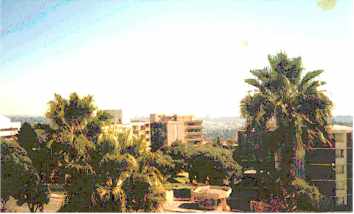 |
Something that was a real pain even in Sandton was the fact that you could not walk the streets because you could not be certain that you were safe from the people who were hanging around. You are an ignorant visitor- you simply do not know where danger lies- but you have to assume that anyone can be a danger to you. I was fortunate that my hotel had a (guarded) overhead walkway to a shopping mall in Sandton!
At the time I did not have a driving license and relied on taxis and colleagues and customers to get me around. Even this can be dangerous as many of my taxi drivers were armed and some taxi wars were underway. In fact, it was my visit to South Africa that finally gave me the incentive I needed to pass my driving test- which I promptly did on my return- because there was simply no other convenient and reliable way to get around. Even car-jacking was rife and locked doors were essential at road junctions.
FIRST DAY NOTES
I made some notes after my first day in South Africa. They read:
1& 3 world by color
No bikes
Hawking junk/ begging/ scavenging/ waiting
Segregation
Things have got better
Need a car
Security versus blacks- invisible fences
Sell Big Issues magazine
No sport seen played
Integrated nursery school
Dual names for towns
Taxi driver can’t read
Superior white attitude
People build their own houses on their plot
Check guns at the factory gate!
I was on my way to a Coca-Cola factory and the taxi driver took a wrong turn into the industrial suburbs populated solely by colored people who were waiting around talking in groups or walking (there were no bikes or games being played to be seen anywhere). During my stay, I asked one of my colleagues to drive me out past a township where the colored people were forced to live under apartheid. It is possible for a visitor not to see these places at all. We drove past them and I saw lots of small brown huts made from corrugated iron and washing lines and people walking around. You notice the closeness of the properties to one another and their apparent openness. On the outskirts of Sandton, yet there were no tropical trees.
 |
I really liked all of the people I met in South Africa- they seemed to be down to Earth and philosophical and enthusiastic. They were working through a major transformation in their living environment and trying to understand the past and the future. Generally, South Africans are loud and lively, yet thoughtful and intelligent.
MIDRAND
A lot of the work I did was carried out in Midrand, a town located midway between Jo’burg and Pretoria. As these two cities have expanded outwards, they have sporned this new town which just ten years ago was farm land. Nowadays, you have a American-style development of new roads and strip malls and offices. The business parks are gated- you enter by passing a security sentry- in fact, one of the walls around a business park was so new and put up so quickly that it collapsed.
UNORGANIZATION RATING
HUMANITY: 2.5. The people in South Africa are introspective and philosophical and in therapy making sense of the past, present and future. They can be pragmatic and astute too. I like them a lot.
QUALITY OF LIFE: 0.5. There are some great restaurants, and I hear that you can walk around freely and safely in Cape Town and on the Gold Coast.
SAFETY: 0.5. It was generally safe inside- offices, hotels, shopping malls etc. But outside- on your feet, in cars, anywhere- safety was a constant concern.
GOVERNMENT: 1. The South African government has- albeit in a flawed positive discrimination kind of way- helped the transition to a more equal society. There is however a long way to go, and more radical wealth creation rather than redistribution ideas are going to be necessary to speed progress.
PROSPERITY: 0.5. Many people are reasonably prosperous, although in a country with high levels of natural resources such as diamonds, you would expect the benefit from this to be more widespread.
TOTAL: 5 out of 10. South Africa is on the up and up. The majority of people are right-minded and I only expect more progress in the future.
The United States of America
I have had the good fortune of spending quite a lot of time in the US since being a child. Some of the times that stand out include:
"Is it yummy?" This was what the salesman asked me at an ice-cream parlor in the Florida as he handed me a plastic spoon with a sampling of "Smurf" flavor ice-cream- blueberry with pieces of marshmallow. It was, but I will never forget that salesperson putting on a huge smile and using that phrase!
I stayed at the Lawrence Welk Resort in Escondido, San Diego, California. Mr. Welk was apparently a famous singer- there was a gold statue of him at the resort! This was a high-end resort with not one but two 18-hole golf courses. (See http://www.pacifictimeshare.com/welk.htm). The stand-alone apartments were large and spacious. And there were very few people there- mainly retired seniors, i.e. old! This was the only place that I have fished- there were so many fish in the reservoir that it was almost impossible not to catch something! It was great to have Jacuzzis and swimming pools and pool tables all to ourselves! It was definitely an enjoyable and relaxing holiday- I have since heard that they have expanded the complex with more accommodation and a bowling alley- I hope to get back there one day!
On that same trip to California, we crossed the border into Tijuana, Mexico, passing the "LAST EXIT!" signs. As English tourists, we made the ultimate mistake of following a tour guide written for US citizens. As such, we crossed the border into the ultimate road traffic chaos- driving in a street market- without any insurance on our rental car! We proceeded to go around a roundabout and head back towards the USA- parking in a car park near the border.
We then went and had a look around Tijuana, which was full of:
market stalls selling the same leather goods
small children following us around and pulling our clothes
bars for the young people to visit from the US and legally drink in and
auto-repair shops for cheap car repairs.
Tijuana is the only place where I have ever seen 100% pure alcohol on sale- I have no doubt that a mere sniff would be pretty potent. We also eat in the most rundown fast-food restaurant I have ever seen- a Wendys. And when we had seen enough of this menagerie, we tried to cross back over into the USA.
And we did not have our passports, because the US guidebook had said that we did not need them! So we found ourselves standing in front of this huge, armed US customs official with no identification! In the end, my mother got out her English library card as ID and the customs guy looked so pitiful towards us that he waved us through and back into the US!
Tijuana clearly had a role to play as a border town- however desperate it seemed to me. I have absolutely no doubt that there are some beautiful places within Mexico that I hope one day to see.
I kept a diary during a two-week holiday to Miami and Orlando Florida in 1992.
MIAMI 1992
Monday 27JULY92
La Costa Beach Club, 1504 North Ocean Boulevard, Pompano Beach, Florida.
The nine-hour flight was good as nine-hour flights go, Richard Branson himself was on board, and each person had an individual video TV (I watched three films on the way!). We've been out shopping on the last 2 days (well, the only 2 days), to a flea market (huge) and to a Mall today (5,000+ shops!) where I got some cheap clothes, American GQ etc.
The sales assistants all pretend to be interested in your well-being so instead of answering "Fine" as expected when they ask "How are you today?", I try to engage them in conversation about the state of the world and so on. But nobody wants to talk about anything of substance over here.
I bought this really garish multi-colored cheap shirt to embarrass myself sometime. The sales associate couldn't work out why we were laughing so much. I gave this women a single red rose after she let me have loads of Coke cups!
Everything here is very, very cheap, half UK prices, because competition is strong. (It is the free economy gone mad). The consumer is king here, you get goods cheaper if you're nice to the sales assistant! Price and not quality is important to the Americans. There are seven telephone companies to choose from and you press the button on the payphone to select which one you want to use.
It is 90 degrees Fahrenheit plus all day, the apartment is too cold because of the air-conditioning and outside is too hot! The beach is lovely and we've been playing catch and tennis etc. which was nice. There is ample water (two outside pools, one inside, two Jacuzzis, one spa and the Atlantic Ocean!). Last night we went to "The strip" to a club called "The Candy Store". The strip is where all the US people our age "hang out" and was busy for a Sunday night.
I went to a nightclub with my cousin at about four in the afternoon in order to get our hands stamped so that we could get in later. We killed some time in the outside bar. We were charged $8 for two drinks. Mum said we should have taken them back and told them we were underage. The waitress looked mortally wounded when we only tipped her $1! The bar people kept asking us if we wanted a Budweiser- the bar staff kept coming by our table every ten minutes or so asking if we wanted another drink. They were smiley and at first I thought it was friendliness until it got be so repetitive that it was clearly a taunt. When we finally went into the nightclub, it was full of old people (in their mid-20s!).
In the gents "restrooms" at the club, two huge blokes were turning the taps on for you, passing you a towel etc. They had a long row of aftershaves from which you could choose! A man asked us if we wanted a spray! We left very soon thereafter!
It is the law to wash your hands after going to the toilet over here by the way. You have to be 18 to smoke, 21 to drink and go to clubs etc. but its not so very strict (we got in!). You only have to be 16 to drive so a lot of kids our age 'cruise' around in great cars, which are so cheap. I think 18 should be the age for smoking, driving and clubbing myself.
Tomorrow (Tuesday) we're off to Orlando to Universal Studios.
Gateway Inn, 7050 Kirman Road, Orlando, Florida. Tues 28JULY92
We decided to sleep over here in Orlando for two nights as we are three hours drive from Pompano Beach. Tomorrow its Universal Studios, today we went to "Wet'n'Wild", a water slide park very nearby. We stayed in the same hotel five years ago and it is still really nice. Its quite near Disney and there is lots going on. At Wet'n'Wild, I tried knee skiing for the first time: you get whisked at 16 mph around a lake by a pully. I came off trying to turn a bend! They told us that if we fall off, we should hold onto the rope which I did- this took me flying through the air! I was clinging on for dear life! Its so very nice to visit a new place and do new things like this. It broadens your horizons.
Traveling to Orlando gave me more of a look at US-style healthcare. Hospitals ("medical centers") are given star ratings and some advertise that "walk-ins" are welcome! Hospitals are much more like hotels over here!
We've all just been to a restaurant called "Red Lobster", a seafood place. An American couple on the text table had a row during the meal and wouldn't talk to each other and so the restaurant put their food in these boxes for take away.
I didn't like the pasta dish that went with my chicken, so the waitress (Josie) bought me another dish for free! Coca-Cola refills were free also and the waitress got so used to my requests that she bought me a few "to work on"!
Sunday 2AUGUST1992
Its Sunday morning at 10 am and it is already over 90 degrees. For the last couple of days, we haven't been far from the hotel. Yesterday (the first time!) we didn't even go shopping.
Monday 3AUGUST92
I've had a relaxing day today basking in the sun. My parents went off on a boat trip visiting the star's homes around Miami. I'm not interested in that sort of 'supermoney' lifestyle- I couldn't have gone.
I had my haircut by a guy called Herman and it was very enjoyable. He was a character: Argentinean, covered in costume jewelry etc. He had a huge ring proclaiming him to be the 'World Champion' hairdresser and on his business card, aside from "International Master" was Ph.D.- quite impressive for a hairdresser I thought, then he told me that it stood for "Professional Hairdressing Diploma" and not "Doctor of Philosophy"! He cuts all the star's hair such as James Bond (he showed us his photo album) and now I'm in there too! He had hundreds of certificates and medals. He gave me a copy of his personal pledge: believe in yourself and don't listen to negative friends and family. I liked him, he'd made a go in just a really average job. He had turned a routine necessity into memorable entertainment.
I knocked over two cups of Coca-Cola in McDonalds in one visit! The checkout girl asked if we came from Germany (after I asked her who did her hair!). It seems to be fashionable to wear curlers outside here. Many do.
Wednesday 5AUGUST1992
Its Wednesday evening and for the last couple of days we experienced our first Miami rain. It hammers it down, and yet is still very humid. I hope the sun comes back, my tan is fading! I'm having a lovely holiday here, laughing a lot.
We met a couple of American children in the pool- Danny Rochelle and Matthew. They are four and three. They call me "poo poo Semen"!! She doesn't know how many brothers and sisters she has because she can't count but she knows what her mum's name is; its mum! They have a lovely seven-week-old brother and there's also a one-year-old today baby girl who swims well and loves it!
We're going to the cinema tonight to watch "Mo Money (The Best things in Life are Free)". True!
Thursday 6AUGUST1992
Its Thursday evening and today we went to the Florida Keys to "The Theater of the Sea" and then to the Everglades National Park. We didn't stay long at the later.
On the way we listened to the People's Court on radio. For minor offenses, if both parties agree, court cases can be heard on the radio and tried by the listeners! You vote in with your verdict after hearing the evidence!! Only America would have this!
We saw some sharks at The Theater of the Sea. Did you know that they get better after being injected with cancerous tumors? They are immune to heart disease etc. and the researchers there were trying to find out why so as to find cures.
There were no 'hoverboats' that travel on the surface of the water at the Everglades because of the noise pollution (I agree). 'Thrill rides' were not allowed. All the American businesses seem to recycle avidly e.g. the water in public parks used to sprinkle the grass comes from homes (!) etc. The future is on our cans! But households don't apparently do much at the moment by way of recycling.
In sum, I have had a great couple of weeks here- with just the right combination of relaxing, shopping, sightseeing and so on. I have met a lot of different characters and learned a lot about the US!
It was not until I started working for American companies that I got to spend serious time in the US and get to know the people and places well. I wrote the following pieces in the late summer of 1998 when visiting with my employer who was based in the Atlanta area in the Southern United States.
MORE BUST THAN DAVE AT DAVE & BUSTER’S
My US-based employer organized a social gathering for its employees and their families at the "Dave & Buster’s" in Alpharetta, Georgia, USA in early October 1998. Dave & Buster’s is a restaurant, bar and video game complex. According to D&B’s restaurant place map, by mid-1998, there were a dozen D&B’s across America as well as one in the UK (in Birmingham). D&B’s were "Coast to Coast and Coming Soon to Other Great American Cities". On June 26, 1995, Dave & Buster’s Inc. became a public company on the NASDAQ stock exchange trading under the symbol "DANB". The place mat told me this too- it is very usual in America for companies to publicize their stock exchange ticker symbol.
I arrived early because I had had to check out of my hotel. I had a look around the Dave & Buster’s facility whilst I was waiting. I bought a swipe card with $10 credit and played a few games. You played the games using a swipe card and got paper tickets according to how well you do. I checked my tickets in at the winner’s counter. They had a really cool automatic ticket counter that told me how many points I had accumulated. I turned my untidy pile of paper tokens into a simple printed ticket denoting my points total.
Then still with some time to spend before my colleagues arrived, I asked the greeters at the reception how I could play pool as there were lots of tables, all unoccupied. I was surprised and offended when the lady said that the cost was $8 a hour and that I could only have the pool balls if I gave them a passport, "major" credit card, or driving license. This was security against using a case of pool balls 20 yards away into the next room inside the Dave & Busters facility. I would have had to go out to my car a hundred yards away to get this identification. (I never did establish what constituted a major as opposed to a minor credit card!). I was offended by this lack of trust and refused. In my notes about the place, I described this as an unnecessary, overzealous, untrustworthy policy.
Thereafter, I started to take a closer look beyond the ritz and glitz of the Dave & Buster’s center at the policies that were pasted in various places all over the facility. I realized that most visitors do not even come across these polices- at least until the D&B people wanted them to do something or they wanted to do something that the D&B people had (often arbitrarily) deemed to be forbidden. These policies were:
Dress Code Policy
The first policy I saw was the Dave & Buster’s "Dress Code", posted on a sign just outside the entrance. It read:
"Appropriate attire required, Clean and neat clothing required. No soiled work clothes. Gentlemen’s shirts must have sleeves. No tank tops or plain undershirts. Thank You."
It looks as though D&B reserve the right to be the fashion police and tell people (their customers) that tanktops and plain undershirts (whatever they may be) are uncool and therefore not allowed!!! And all to get into a tarted-up gambling den!
Policy regarding children
The next policy I came across concerned children. It was difficult not to hear about this policy as one of the jobs of the greeters at the doors was to say to parents with children to keep the children with them at all times (in a polite, friendly way). As it happened, D & Bs had some leaflets outlining their policy. They read:
"A few words about our younger guests.
Dave & Buster’s welcomes you and wishes you the Best of Times during your visit with us.
We respectfully remind you that Dave & Buster’s is primarily an adult establishment. We have long-standing house policies relating to the admission, conduct and safety of underage guests.
These policies, listed below, also are posted prominently at our front entrances.
For admission, guests under the age of 21 (legal drinking age) must be accompanied by a parent or a guardian. A guardian is a person 25 years or age or older who agrees to be responsible for the conduct, supervision and safety of underage guests.
One parent or guardian can accompany up to a maximum of three underage guests.
While at Dave & Buster’s, underage guests must remain with their parent or guardian. Our other guests appreciate this and our insurance carrier requires it.
Underage guests are welcome to stay until 10:00 pm. (From Memorial Day through Labor Day, summer hours, underage guests are welcome until 11:00pm.) After these hours underage guests must leave unless they are already seated in the Dining Room.
This policy was shortened in signs around the building to:
"Please remember… all children must be accompanied by an Adult at all times."
This policy is excessive because it allows children (well under 21s) in the premises until all hours of the night anyway. It is hardly going to make much difference to a young child whose parents or guardians are lapse enough to let them stay in such a facility until 10 in the evening if they are allowed to stay later than that (which they can… provided they are seated in the restaurant). D & Bs is making a legal and not a moral statement (how can it, in that sort of business?).
I can see why this policy is necessary from an insurance point of view. But the place was full of children on that Sunday afternoon, and not principally an adult establishment. It was very dark inside- I don’t know why they don’t turn the lights on in these places. There were people routinely and regularly restocking the games machines with the paper winner’s tickets that the machines dispense. These employees had their heads inside the machine which were flashing and seemed to be switched on- with their bodies laying right across the walkway. This was the biggest danger to the employees- and the guests- adult and children.
Return/ Exchange Policy
D&B’s Retail and Redemption Merchandise will change from time to time. Returned merchandise will be replaced with similar merchandise of the same value if the item has been discontinued. Cash refunds are not given as a matter of company policy.
No merchandise will be accepted for return or exchange later than 30 days after purchase or redemption.
Always send your warranty card, if enclosed with the item, to the Manufacturer as soon as possible. Many manufacturers will not honor late Warranties. D & B’s has no control over the extension of, or the length of period offered for any manufacturer’s warranty.
Returned merchandise must be in the original packaging. Merchandise obtained by cash purchase must be accompanied by the original receipt. All redemption electronics must be accompanied by an original Ideal receipt. Without a receipt we cannot exchange merchandise as a matter of company policy. No warranty or exchange will be honored for misused or abused merchandise.
This is in my opinion another extraordinary policy- only a robot could comply with all the terms and conditions- and all these procedures for low-value toys- usually plush teddy bears and other cheap toys. Maybe you could warrant having a policy for the electronic items and other goods over a certain value- but not for all the merchandise no matter how cheap and tacky it is.
Pool House Rules
Once you have left your major credit card as deposit, there are some house pool rules to follow:
HOUSE RULES
We strive to present our patrons with the finest playing conditions presented in an orderly atmosphere. In order to maintain both the quality of the equipment and atmosphere, we request that all guests observe these house rules:
Players only in the playing area (no-playing spouse or date permitted).
No loud or abusive language whatsoever.
No drinks, cigarettes, or foreign objects on playing tables.
No gambling.
For the mutual enjoyment of all guests… any disrespectful conduct or violation of any house rule will be grounds for discharge. Welcome to the BEST… Welcome to D&B. Please enjoy.
They make it all sound as though it is for the benefit of their guests- and not them. I cannot believe that they specify that one spouse or date can be present- how generous of them!! What is the matter with the people who put these policies together- what are they lacking- Self-confidence? Brains? Humanity?
These polices are often arbitrary and always excessive. I do not know the extent to which these kinds of rules are specific and unique to D&B’s or widespread and typical in the US. I suspect that it must all have to do with the seemingly American inclination to sue each other when the slightest incident happens. There can be no room for any leeway because no-one trusts each other, so everything has to be laid out clearly. Even accepting the need for some policies such as accompaniment of children, I see no reason whatsoever for the excessive and arbitrary nature of much of the detail in these policies:
The pool deposit is offensive and unnecessary- there is little chance of balls being stolen anyway so why punish everyone for the sake of the worse case scenario.
The dress code is offensive and unnecessary- no-one has the right to tell other people (especially customers) what they may or may not wear.
The Return/ Exchange policy is excessive and unnecessary- who cares about little juggling balls and cheap calculators anyway?
Attempts to control who enters which PUBLIC, OPEN area of the facility such as the pool room are a fundamental limitation of human civil liberties which treat humans as cattle who can be ordered around.
I must try to find something positive to say about Dave & Buster’s, and after looking around for a couple of hours, I came across some awards for D & B’s employees next to some good luck messages signed by various B List sports personalities and actors. I was informed that:
"Employees who have served for over 6 months continuously and exemplify our standards for service, punctuality, cooperation and teamwork are recognized with the award of a D&B pin and the addition of a Star to their nametag.
Any employee who has been awarded a Star in more than one department is awarded a gold-color nametag with a Star. Employees who have held Stars for over three years continuously are awarded solid brass nametags with Star. Employees who have held stars for over 5 years continuously are awarded solid silver nametags with Star. Employees who have held Stars for over seven years continuously receive a commemorative D&B plaque."
Monthly awards listed included: Midway Tech of the Month, Cocktail, Casino, Front Desk, Service Support, Winner’s Circle, New Employee, Shift Leader, Bar, Kitchen Employee of the Month, Waiter of the Month, as well as D&B’s All-Store All-Stars.
I doubt there are many 7 year long staff there- they would be suffering from light depravation I am sure- maybe the whole place is run by vampires???!!! This is so typical of D & B’s policies- prescriptive and precise, with no room for interpretation, flexibility or freedom.
The negative and arbitrary policies leave me imagining some sort of late night siege in which mad children throw pool balls at each other whilst wearing tank tops and damaging the toys they have won before trying to return them for a refund!
These policies are unnecessary and plain wrong. They should be abolished. D&B’s should be avoided. It reminds me of the headline in "Wired" magazine’s article on Singapore: "Disney with a death penalty". Behind the thin veneer of enjoyment and friendliness lies a raft of defensive policies.
I LIKE DRIVING IN MY CAR…
I do not like driving in the UK, my home country, at all. Parking spaces are non-existent or narrow and roads are cramped. In Europe, I travel around by train or tram or taxi. However, there is a necessity to drive in the US due to the lack of pedestrian walkways, of taxis, of public transport, of closeness and proximity of places. As such, I knew that I needed to drive and hired a car for my 10 days in Atlanta. This was the first time I had ever hired a car when traveling. When the lady in the Alamo rent a car office said she was "bumping me up" from a mid range saloon to a Isuzu Rodeo, I thought I’d had my first accident before even getting into the vehicle!!
Anyway I soon found myself behind the wheel, and after I had asked someone how to use the automatic controls which I had no familiarity with, I was on the road. To my surprise, despite my extreme reluctance to get behind the wheel in England, I found driving in the US to be relatively easy. There were a few different reasons:
Automatic controls. It is nice not to have to keep moving and up and down gears as you do with a manual gearstick or "stick shift" as Americans like to call it. "Cruise Control" is another great feature for automating driving- simply get to the speed you want to travel at and press the cruise button and let the car carry on at that speed itself until you need to speed up or slow down, at which time, cruising is automatically canceled.
Less disciplined lane hygiene. In the UK, there is a relatively slow lane in the left-hand lane and a fast lane in the right-hand lane and it is quite unusual to see someone overtake on the inside. In the US however, the fast lane is the inside lane and if you are occupying a middle lane and going too slowly, traffic routinely overtakes on both sides. This happened to me a lot! In the UK, such hogging of the middle lane would lead to headlight flashing and horn beeping- in the US, no such aggressive and hostile behavior occurred. This is one case where "opporTUNEitizing", i.e. having flexible rules that can change when the situation does, is very advantageous. The same rule about overtaking exists in the US, but is not enforced.
Courtesy. Other motorists showed me a lot of courtesy. On a couple of occasions, I found myself doing the wrong thing. In one case, I was about to travel on the wrong side of the road until another driver flagged me down. In the US, there just seemed to be a greater tolerance of the fact that human beings are behind the wheel and humans are not perfect and will make mistakes occasionally. Coupled with more flexible rules and user friendly car technology, the chances of these mistakes causing harm is lower in the US than elsewhere.
Filter right on red. It is arbitrary and senseless to have an inflexible rule that says that if the light is red, you must always stop. If there is no other traffic on the road, then being able to enter the road when you are in the right hand lane with a clear road ahead is sensible. opporTUNEitizing again.
Parking lots. Easily the most luxurious and convenient feature of driving in the US is the ample and spacious parking lots. There is typically parking in front of, at the side of and behind stores and restaurants and cinemas and hotels and offices. It was so nice to be able to pull into large parking spaces wider than the width of the vehicle and without being surrounded by lots of other vehicles. And of course, many places have valet parking anyway, so if you really could not or did not want to park, you could get someone else to do it for you and pay a couple of bucks for the convenience.
The way the road signs are all explicitly labeled north, south, east and west helped me with navigation. I was very quickly able to navigate myself around Atlanta and its suburbs because I knew that if I wanted to go towards the city from Alpharetta, I needed to head south, and to get back out again, I needed to go north. Easy! In fact, highways running from north to south in the US have odd numbers and highways running from east to west are even-numbered.
One thing that did surprise me was the myth of the wide open road- my expectation that roads in the US were wide and convenient for drivers. When a colleague and I drove from Atlanta to Charlotte, North Carolina, most of the road- even on the Interstate (motorway)- was just two lanes wide. We often got caught behind other traffic because we could not pass using either lane. The wide roads with a few lanes in both directions do certainly exist, but the roads seemed to get wider as you approached cities. You could tell how close you were to a city from the width of the road!
I went to America with the belief that there is something unsatisfactory and even uncivilized about a society in which you have to drive to get anywhere. I got used to the drive-thru banking machines (ATMs), pharmacies, restaurants and so on. I still regret that fact that there were few pedestrian walkways, even linking one mall complex with another adjacent to it. But I think that if you have to drive everywhere, you may as well take as much of the stress and strain out of driving as possible with these and other practices.
(Thank you to my follow drivers in and around Atlanta in September and October 1998 for making this article possible!).
CREDIT RECORDS… "DO NOT HONOR"
It seems as though you have to have a track record in America. You have to have a sound credit history and a sound employment background… you don’t have much of a chance to stuff up- if you get into debt, this remains on your credit record for seven years. I saw the urgent need for money in Orlando, Florida in particular where the stores were advertising services such as advances on pay checks and signing over ownership of vehicles whilst keeping the wheels to drive yourself.
In both Europe and the US, there are groups of people who use money for their conspicuous consumption- for their car and their holiday and furniture and so on. In the US, middle class people are consuming conspicuously too… buying things that look cute but they do not need. However, there is also a class of people in the US and Europe who need money to make ends meet- in the US it’s those people on the front lines such as the taxi drivers who have to work double shifts to earn any "decent" money. One taxi driver told me that he moved from New York to Orlando to escape the pollution. He explained that if you had to be poor, you may as well be poor in a hot and relatively clean and safe city.
A teenage boy came over to me in an Atlanta shopping mall and persuaded me to buy some "Honey Roasted Peanuts from Colonial House" for five dollars. His canned and clearly oft-repeated speech was that buying the nuts would help keep him off the streets and away from crime. He told me that he sold six or seven boxes a day- every day. I saw him busily and eagerly counting his bucks later that day- an entrepreneur in the making.
And at the other end of the scale, I heard the "IPO" dream talked about constantly by private companies. Everyone was looking to take their company onto the stock market through an Initial Public Offering. This would turn companies just a few years old into multimillion dollar corporations.
What I disliked most about America was that there was no trust whatsoever when it came to purchasing things. Once upon a time, we were advised to "Trust, but verify". Instead, today’s credit policy seemed to be "verify, verify in advance". Everything was paid for in advance- hotels, hire car, flights, even the pool balls for a pool table required a "major" credit card to be left as deposit (See the "More Bust than Dave at Dave & Buster’s" above for a detailed explanation). When I arrived in the US, all of my money was in a current account and I had no credit available in my Visa account. So I paid everything with cash. When I gave my credit card to my hotel to see if I had any credit left, they rang in and the electronic voice read back the message "Do not honor… do not honor". For me, this summed up the American approach to customer credit.
BASEBALL AND COMMUNITY
During my short time in Atlanta, I had the pleasure of attending two baseball games- the Atlanta Braves versus the New York Mets and the Chicago Cubs in a play-off match. Having never watched or played baseball, this was an interesting time for me.
The spectators really got involved in the game, with chants and cheers at certain times and fireworks whenever a home run was scored. Electronic games were played on a giant video screen such as follow the ball as it moved under baseball caps. This video screen really added to the event- with replays, highlights of important home runs being played at other events, match statistics and so on. Whole families were there together. There were lots of different restaurants and bars and a play area where children could run the distance between the bases and test out their hitting skills. Periodically, staff used guns to fire Braves T-shirts into the crowd.
In the first game, crowd watching and atmosphere soaking were my main concerns over and above the baseball game itself. Then I was accompanied to the second game by an expert in baseball who explained what was happening below. Some of those people who I thought were just poor batters turned out to be deliberately sacrificing themselves for their teammates who were already on other bases. At the second match, the game was my main focus of interest.
The enjoyment of the whole baseball trip was a combination of the game itself and the audience dynamics. We were high up in the "nosebleed" seats, so that sometimes the audience dominated my attention over and above the mini-figures far below. For me, baseball offered the ideal combination of entertainment on the pitch and entertainment off it. Both were present- the atmosphere was great and the team was winning. And all for just 9 or 10 US dollars- not a lot at all for this level of entertainment, and low compared with the cost of visiting say a soccer match in the UK.
My visit to the baseball games had been organized by the Atlanta Chapter of the Coca-Cola Collectors Club. That same week, they held a picnic at Stone Mountain where they did not cook the food themselves but instead got a local restaurant to come out and do all the catering for them. People of all ages turned up, old and young, and of course everyone was friendly and kind because of the common interest, and just because that’s the way most US people are.
What struck me about this baseball game and other occasions in Atlanta was the community element. The fact that groups of people of all ages went out and enjoyed themselves. Community is an essential element of American life- but at the same time, people seem dispersed because of employment. It seemed that family mattered, but money mattered more. I met and came across many people who had family distributed across the country. People are inquisitive the whole world over, but in the UK, people just look- in the US, they talk to each other. Nowhere outside America is there a greater propensity to talk to strangers when standing in line. People will strike up a friendly conversation about where others are from and what they are doing. At the beginning of my trip, I found this level of interest a little intrusive- until I realized that it was just me being defensive. Funnily enough, I perceived some reticence when it came to business contacts- receptionists at companies I visited were sometimes a little standoffish. People were a little more reserved than I expected when they were not approaching you or when it was a business rather than a social context.
I played soccer in the US and I was surprised by the number of spectators who turned up with their portable chairs and coolers full of drinks and food. Again, families attended. I enjoyed playing in soccer- even if the game I played in was non-contact! I could not find a pair of white shorts anywhere in Alpharetta’s North Point Mall, so the famed US shopping paradise let me down there! I bought some shin guards because of the league regulations stipulating that people may not choose to stupidly endanger their own lives. I was amused to see the legal WARNING on the inside of the guard that reads "Soccer pads protect against minor scrapes and bruises. Soccer pads do not prevent fractures or other injuries to the leg, ankle or knee". Only in America! The manufacturer protecting themselves against getting sued.
I spent only a few days in the US, but I have rarely attended so many social events organized by my employer and clubs and organizations. There was always something going on and some event to be a part of. It is important for people to be able to approach strangers of different ages sharing a common positive context without fear of rebuke. It is nice to be able to go out with your family and friends to different events. I very much liked this element of community in America.
I found that the aspects of community between people made up for some of the blandness in buildings. I suspected that the novelty of being in America could wear off very quickly. Once you had seen one shopping mall, you had seen them all. Seen one road, seen them all. Seen one office, seen them all. Seen one restaurant, seen them all. I wondered how the shops could compete when they were all offering the same merchandise, the same low prices, the same convenient locations and the same high level of service. At best, there are minor variations on a common theme- all those different chicken restaurants- just how many ways are there to cook chicken anyway??!!
Like every other place, America is not perfect. But I like it- I like the people and the politeness and the inquisitiveness and the commerce and the space too. A miracle America? No- hard work. But America contains many examples that the world can learn from.
UNORGANIZATION RATING
HUMANITY: 2.75. America is one of the few places in the world where many people actively take an interest in where strangers are from and what they do. People tend to offer their opinions very freely, whereas in Europe they tend to need to be prompted.
QUALITY OF LIFE: 1.5. There is plenty to do in America, with cinemas and sports and outings and so on available at affordable prices. The architecture and shopping can however be repetitive- seen one mall, seen ‘em all.
SAFETY: 1. America is a reasonably safe country- but ownership of guns is high and being the wrong person in the wrong place can be dangerous.
GOVERNMENT: 0.75. The US government is accounting for a gradually increasing proportion of national wealth. At least they recognize the importance of things like the Internet and have suspended taxing it for a while. The best thing about America is that people still question the role of the government and are skeptical about everything it does- in places like the UK, the existence and actions of the government are simply taken for granted.
PROSPERITY: 0.5. Americans pay high overall taxes- but lower than those incurred in most European countries.
TOTAL: 6.5 out of 10. America leads the way in terms of positivity, proactive communication, entreprenurialism, openness and prosperity.
Asia
JAPAN
After reading about and studying Japanese language and management at university, I was delighted to finally make my first visit there in January 1998 for 10 days.
I really enjoyed the politeness and honestly that I found in Japan. I enjoyed bowing my head all the time and trying to out-polite my hosts! Certainly, Japanese people are very helpful to non-Japanese- on a couple of occasions I stopped amidst a sea of people and looked lost. Seconds later, people voluntarily stopped and were asking me where I wanted to go. Twice, people who I asked directions from actually accompanied me over a kilometer towards my destination- once, trying to find the site of the Coca-Cola Olympic torch relay on Route 248 in Tokyo (a very fashionable area) and once trying to find some company offices. It was probably easier for them to show me than explain it to me!
Perhaps because of the rapid speed at which Japan has grown, you find many contradictions which make understanding Japanese people quite difficult. An example is cleanliness. Japan is one of the cleanest places in the world- people take personal hygiene seriously. Perhaps it’s the proximity on some rush hour underground trains- although such conditions do not trouble some people on London’s underground! Not all rush hour trains were busy- and the atmosphere was not hectic- people were methodically making their way to work in a calm manner. You see advertisements on the underground trains in Japan offering solutions for every embarrassing ailment. When a Japanese person has a cold, they volunteer to wear a facemask to minimize the chances that they will spread their ailment to other people. On one hand, people keep the area outside their shop or home clean, for example, sweeping away snow, yet, on the other, people routinely spit, vomit and urinate onto the ground, especially men returning from work via bars late at night.
The youth district of Tokyo, Shibuya, reminded me of Covent Garden in London.
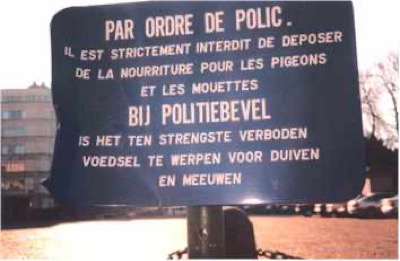 |
The shops were small specialty retailers selling comic books, cards and stationary, lighters, clothes, shoes, nicnacs, beads and so on. There were lots of restaurant chains- notice I say chains rather than the small businesses more common in European caf' culture.
The main difference between central Tokyo and central London was that the former is a mono-culture, whereas the later was a truly diverse place with nationalities spanning the globe represented. In Tokyo, diversity was symbolized by Japanese people wearing different things- dying their hair a bright color or wearing a strange uniform. Once, there was a shortage of a particular new model of western training shoes, but instead of buying another model in their size, people bought oversized shoes, starting a trend. You still saw people in Japan wearing shoes with wide ends that looked like flippers. Non-Japanese people really were a minority in Tokyo- whenever I saw them I was surprised and tended to say "Hello". All of the Japanese children- boys and girls- were wearing their school uniforms- on a Saturday!
There were lots of machines that the Japanese people used for entertainment and convenience. For example:
Pacinco. I played Pacinco at a games parlor- this is the Japanese slot machine game which involves trying to direct an automatically generated flow of silver balls to fall into certain holes built into the display in the games machine.
Vending Machines. Rows upon row of vending machines from different manufacturers could be seen in Japan- especially for drinks.
Cash machines. It did bother me was that the ATM cash machines closed down between certain hours- what is the point of having technology to dispense cash, but only when the branches are open anyway? Maybe it is a job protection measure- it is certainly inconvenient for consumers.
Photo Shops were a big craze whilst I was in Japan.
They were a particularly popular activity particularly for teenage girls. The machine takes a single photo of you with a chosen background and prop, such as a Coca-Cola bottle! You then confirmed that the photo is okay and the machine prints out sixteen small stickers, each with the photo on it. The photos are the youthful equivalent of business cards in Japan- the idea is to exchange them and try to have your photo taken with as many different groups of people as possible as a souvenir of an occasion.
I saw a great interest in product innovations in Japan- Japanese consumers liked western brand names and were also willing to try new gadgets and ideas from small local companies. One thing that I could not find anywhere in Japan was picture postcards- there is a big opportunity for someone to introduce them. Another good idea- that I heard about but did not see- is earphone alarms. People in Tokyo will snatch some sleep at any time- mostly on the underground. They would find it useful to have a device that they can use as a timer to wake them up when they get near to their stop!
THE SEPARATE LIVES OF MEN AND WOMEN
Certainly, at the time that I visited Japan, there were set roles for men and women- men went to work and women to the shops. The traditional division of responsibilities tends to remain the case in Japan long since it has ceased to be so rigid in the west- because orderly structures such as stable employment and stable marriages tend to persist in Japan.
Women seem to live separate lives from the men- I went into an NTT center- NTT is the fixed telephone service like BT or AT&T in Japan. To my surprise, rather than finding displays of phones, I found a busy center filled with women taking cookery classes. It was similar in the Sony Centers that can be found in the major cities such as Osaka and Tokyo. All you see on the top level of the Sony Center (you start the tour on the top floor and work your way down) is traditional painted pictures of landscapes- a strong hint that technology is rightly considered a tool and not an end in itself. Lots of the major Japanese companies have corporate showrooms open to the public- Toshiba, Nissan and so on.
Men have a difficult time in Japan. The salary man goes to work to spend his time doing specific work in a strict hierarchy for long, long hours. You don’t stop work at 5- you carry on in the office until 7 and then onto the bar with colleagues for late night drinking. (In other words, you go from one set of bars to another). Work dominates life out of all and any balance with other interests such as family. Then again, you see lots of male workers in suits walking the streets and on the underground at quarter to four in the afternoon.
Women on the other hand shop a lot and have the freedom to run the household, look after the children and so on. This is enabled by the income-earning activities of their salary men husbands. The majority of people you see shopping are women. It was however hard to distinguish browsers from buyers- people apparently buy something from a designer boutique and then re-use the paper bag that item came in again and again- who says conspicuous consumption cannot be environmentally friendly! Just about all of the women- young or old- had a handbag with a designer name on it- Gucci or something like that. Most of the users of mobile phones on the streets were women. There were even popular mobile phones that were rose in color and had "cute" cartoon characters on the screens, designed especially to appeal to female mobile phone users. These phones subsequently became very popular with men- who seeing that women liked them, started to buy them too!
Nearly all the laughs I heard on the streets are from women- men didn’t smile much. For a collectivist society, I get the impression that people are pretty lonely, especially the men. There is a lot of superficial politeness that makes finding and getting yourself around easier, but beneath that surface are many rules regulating who talks to whom and in what form.
Given this strict division of roles, men end up seeing little of their wives. Relations between husbands and wives are often uncomfortable. As a result, relations between the opposite sexes tended to be frustrated- when contact does arise, it is not casual or relaxed. Conversation is not really routine. Men and women do not seem to have casual relationships in the way that is routine in the west. Groups of women and groups of men travel together to a greater extent than in the west. Soft core pornography was popular with the men- much of it in the form of cartoon books read on the underground. Longing looks at women seemed commonplace. Groups of men opened up their newspapers on the underground and looked at and discussed the pictures of girls in the classified adverts.
Japanese women tend to like non-Japanese men, whereas non-Japanese men do not have so much success with non-Japanese women, who don’t tend to want anything to do with them. As such, Japanese men lose twice- they lose the Japanese girls and don’t win the non-Japanese girls. Japanese girls often like to talk to English-speaking men, because the English they learn for six years or so at school tends to be rote learning and very unnatural- like the conversations between Japanese men and women! All that time spent and so little learnt- it reminds me of learning Japanese where I could just about order a taxi ("Taxi!"!) by the end of my first year of learning about the culture, reading and writing! A few older Japanese men made some comments to our group when I was traveling with Japanese girls in the Kyoto area. It is quite rare for such comments to be made audibly in such a collective society where embarrassment is avoided. I don’t know what the comments were, but they were not friendly.
WORK ORGANIZATION IN JAPANESE OFFICES
I had the opportunity to observe a few Japanese offices and watch the employees work. In an elevator at "The Japan Times" newspaper building in Minato-Ku, Tokyo, I read the following sign:
"To save electricity, please use the stairs when going up or down one or two floors. Administration Department."
The offices in Japan are all open-planned, but to varying degrees. I saw one office that was cubicle-based with low dividers between the different people in the cubicle- but with piles of documents on the filing cabinets to obscure the view of each other. Another had very low separators that were below head-height- you could see people’s heads and shoulders but you could not see what if anything they were working on using their PCs or desks.
There was a floor plan pinned to the separator board on everyone’s desk. One person, holding the senior rank of General Manager, sat in the middle at the back of the room. He did not seem to have any more space than anyone else. Interestingly, there was an in and an out-tray on everyone’s desk apart from the senior people on the back row who had none. They probably had a secretary who received their documents initially. The general manager was working through the files of job applicants- ringing them up to arrange interviews and usually leaving a message on an answering machine. Perhaps this is a symbol of the commitment of Japanese bosses to their workforce, or perhaps it is a reflection of the likely lifetime nature of employment in Japan, and therefore the need to recruit well.
In one office at 6.40 in the evening, all the desks were still filled. Everyone did a very good job of appearing to be busy- peering closely at their screens. They did not look up and glance when colleagues passed by their desks. It was quite quiet- people were talking on the phones, but quietly. The Japanese office environment was not therefore tremendously different from that elsewhere in the world- the same underlying themes were present- a palpable lack of momentum and a closed environment which the same people frequent day in and day out.
By 7 p.m., people were starting to leave. They did not look at anyone or appear to even say goodbye- they just got up, keeping there head down, went over to one of the several white boards on the walls around the office and deleted some symbols- presumably their names. Off they went, collecting their coat from a communal stand. Between those that remained, conversations started to spring up, particularly but not exclusively between the females. One person sat and talked, whilst the other was standing close to that person’s desk. I left for dinner with one of the senior people soon after, and do not know whether or not his departure spurred a mass exodus. I suspect that it did.
One office had lots of toothbrushes and mouth fresheners in the toilets- because some employees stayed overnight. Indeed, one employee lived so far away that he had his own bed in the office, going home just a couple of times a week. Other people commute an hour to two each way to the Tokyo suburbs where they live, or sleep in their cars. Both taxi drivers and many salary men had cars whose front seat folded all the way back so that they could lie down and sleep in them if they missed the last train home after a drinking session. Indeed, early in the morning, people could often be seen asleep in their cars. Teleworking- working from home- is not really an option in Japan- not because of a lack of technology, perhaps because of a lack of space in the home, but mainly because of the importance of observation and interaction with bosses in the hierarchical Japanese organizations.
UNDERSTANDING MEETINGS IN JAPAN
I am relatively young, and some of the people that I met in Japan were relatively old. Seniority matters a lot in Japan. This presented some interesting situations. For example:
Some meetings were held in smoky rooms (was this a hint: a reflection of my status?)
More senior people were bought over to meet with me AFTER the formal meeting had ended and things had gone well
At the start of meetings, the senior people avoided eye contact with me, looking away when I looked at them. Of course, by the end of the meeting, their tongues were hanging out!!
Where you sit does apparently matter- people entering the meeting after it had begun could see who the visitors were, and who amongst them was important. The seating position of the employees of the company receiving visitors did not seem to matter as much.
An incident that amused me occurred at the end of one meeting where I was giving a presentation to about a dozen people in a company in Tokyo. At the end of my presentation, I sat down and finished off the plastic cup of coffee that two girls had bought in and served mid-way through my speech. Of course, I did not have the opportunity to stop and protest that they were serving us at all. We were all sitting down, when one of the two Japanese women who had been in the audience got up and started to gather the empty coffee cups from all the people in the meeting. None of the Japanese men took much if any notice, helped or moved. Then I got up and starting helping- gathering their coffee cups. You have never seen a group of people come to life and busy themselves so quickly- the "honored guest" could not be expected to collect the empty coffee cups!! I think that the meeting went well anyway, because the most senior person in the meeting accompanied us down to the reception to say goodbye!
On several occasions, I had the pleasure of being invited out to a restaurant to eat an evening meal with Japanese business associates. I had all sorts of strange food- from fried beef to blowfish to sushi, along with sake and Japanese beer and so on. None of it struck me as amazing- but that may be because I was not used to eating those foods cooked in those ways. I went to traditional Japanese restaurants where your party has a room to itself in which the food is cooked for you by a restaurant assistant. I did try to use chopsticks- it is essential to make a real effort. Upon failing miserably, your host will then satisfactorily get you cutlery!
Anyway, these occasions provided me (and them) with a less formal and more interactive means to get to know each other and find out about where they had traveled and how they felt about their lives and Japan.
APPALLLING CUSTOMER SERVICE
You soon see why unemployment in Japan is so low- people do jobs that are often carried out by machines elsewhere. In keeping with the same trend in America, there are more retail and hotel staff than are strictly necessary, there are people waving motorists past road works and guarding construction project entrances, there are two people serving at the kiosk on the train when one would be enough. There are rail employees pushing people onto trains during rush hour.
That is not to say that because all of this apparent over-staffing, customer service is good in Japan. In fact, there is an inverse relation between quantity of employees and quality of customer service in Japan. In other countries, many of the customer service problems such as queues are caused by too few staff- or more accurately, too little cross training. You do also see staff in London bars wandering around collecting empty glasses as per their job description whilst a huge group of people await service at the bar. The problem is that each of these many people has a specific task to carry out in serving the customer. There is simultaneously over-staffing and under-responsiveness. It annoyed me to see lots of employees standing around doing nothing in the hotel in Japan, whilst there was no-one to carry my bags. Places are overstaffed yet it takes an age to get anything done. When I posted some postcards, when paying my hotel bill, when checking in at Tokyo Narita airport and when getting served in restaurants, it was obvious that there is a set procedure that must be carried out involving lots of people.
When I took some postcards into a post office to buy some stamps, I handed my money to one person, another person then stamped "AIRMAIL" on the postcards, someone else gave me my change, someone affixed the stamps, and I expect someone else put the completed postcards into the airmail bag!
In the same way, I went into a coffee shop and had a strong coffee and a hot dog. When you enter a shop selling food in Japan, all the members of staff greet you. There is a set procedure in place- that may appear to be superficially polite and efficient but which is in fact mandatory and inflexible. There is some imperative to greet every customer, no matter what the employee is doing when they enter. Someone takes the money, someone else gets the coffee and someone else does the hot dog. The customer moves along the "production line", cooperating with the staff to complete all of the set tasks in this process. This may work well with cooperative customers making routine purchase requests, but it did not work with me- try getting your hot dog without mustard over there! And when you leave, everyone says goodbye- unless you do not buy anything, in which case, silence!
In Japan, when you go into a bank, you approach a counter where you talk to one of the counter staff and tell them what you want. You then sit down in a communal area whilst your request is sorted out. This usually entails the counter person talking to two or three other colleagues standing and hovering behind the row of seated assistants. You see this pattern a lot- collective discussion- maybe because my requests were a little different from those of the Japanese people.
As such, Japanese companies need to increase the flexibility of their customer service processes. (See https://www.unorgan.com/customerservice.htm).
DIFFICULTIES IN MAKING TELEPHONE CALLS IN JAPAN
One of the most frustrating and annoying processes in Japan was making telephone calls. It was the first thing to really infuriate me- three full days into my visit. In keeping with most of the (rare) attempts at introducing competition into Japan, the burden of taking advantage of that competition lies squarely with end user. Multiple suppliers offer separate systems that necessitate end users to use different equipment and buy different tickets- this certainly applies to the rail system where different operators run different rail lines, and telephones- where there is currently separate telephone carriers for international calls. Certainly, the telecommunications market is rightly being deregulated, with the long distance company offering local calls and the national carrier offering international services within the next couple of years. And of course there is always a learning curve for someone like myself who is not familiar with the specific systems to make mistakes and waste time early on.
Telephoning in Japan involved:
-multiple operators
-telephone cards that only work for national calls
-different phones for different types of calls
-international telephones that only take coins
-international telephones that only take small denomination coins (100 yen coins, not 500 yen!)
-busy signals continuously
-operators that do not speak English
-different international dialing codes depending on which operator you are using
-a separate mobile phone standard from that adopted by the rest of Asia (and Europe, Africa etc.). Instead of adopting the GSM standard, Japan at that time in the late 1980s had the luxury of being able to afford to finance their own standards such as Personal HandyPhone System (PHS) and Personal Digital Cellular (PDC).
-in my hotel, different phones were located on different floor levels, as were the card and change machines and phones! If you wanted change for the international phone, you had to go up to reception! Procedure-driven customer service again.
ROUTE 18: THE AMERICANIZATION OF NAGANO
I had the pleasure of visiting Nagano, which was the host city for the 1998 Winter Olympic Games. I took the bullet train from Tokyo, taking about an hour and a half, and upon arrival in Nagano, took a taxi to the Olympic Stadium for opening and closing ceremonies. I walked around it and took some photos and then walked the four kilometers or more back from the stadium to the center of Nagano. The brand new road that links the Olympic Stadium with the Nagano city center is called Route 18.
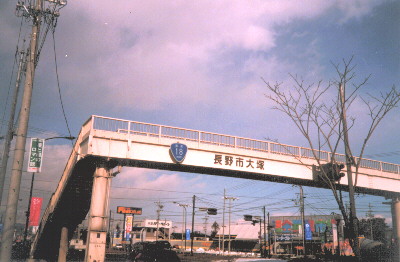
Here we see the true Americanization of Nagano- it is not the fact that most of the top Olympic sponsors are American corporations- it is the fact that Route 18 could- apart from the Japanese characters- be located in the US. Route 18 has a six lane highway with drive-in restaurants, bottle shops, garages and so on. As in America, these facilities are as good as inaccessible to people without cars.
The effect of the Olympics on improving the Nagano infrastructure was obvious- new and widened roads linking the dispersed half-dozen Olympic venues- all of which were newly built for the Games.
RECOMMENDATIONS FOR UNORGANIZING JAPAN
Japan needs to get with the global world. It is unhealthy to be so homogenous in today’s diverse global world. Japan can be aligned with the unorganized world by harnessing and developing the existing positive nascent trends in Japanese society:
Many young women travel abroad and this changes them. They see that they can be treated equally and begin to expect the same respect back in Japan.
The next generation of Japanese people has very different attitudes and expectations. Neither young men nor women are willing to accept the same roles as their parents and grandparents. They will not copy the actions of their salary men fathers- they are impatient with having to wait within the corporate system for seniority before getting promotions and access to opportunities.
Such impatience was one of the main factors why the "Aum Shrinro Kyo" cult religious group that released sarin poisonous gas into the Tokyo subway system in 1995, killing a dozen people, was able to recruit some of the most exceptional science and technology graduates from Japan’s universities. It offered the best laboratories and opportunities to experiment IMMEDIATELY. (I was deeply shocked when upon being introduced to me, one senior Japanese businessman asked me if unorg was a religious cult- now you know why I invest in language translations to fuel understanding!).
Continuing economic problems- pressuring employees and employers to change their policies and practices and encourage innovation and more risk-taking, mobility and flexibility in work patterns and other means of naturalization and downstructuring of work organization.
Continuing dissatisfaction with the Japanese government. The Japanese government was quite stable until 1993, when the post-war Liberal Party that had held power continuously for nearly 50 years was voted out of power. Unfortunately, whatever party was in power could not wrestle away control of the policy agenda from the bureaucracy- the civil service independent of the government.
The Japanese government has been uncertain in handling the current economic crises- or perhaps this is simply a manifestation of the "ringi" collective decision making process that is used in Japan. Not a week goes by when there is not a corruption scandal where someone from a government ministry has confessed to being engaged in an illegal act, with the consequent resignations from more senior government officials taking the blame for the actions of others.
Countercultures. There are several thriving countercultures in Japanese society, such as "manga": animated comics. These hobbies should be developed into full-blown lifestreams through which people earn a living. Commercialization should be facilitated by making it less bureaucratic to set up a retail outlet and small business- such simplicity is the case in Hong Kong.
Tap the willingness of Japanese people to try new unknown products. This is a means of entry into many product categories- try to create a trend and be the next craze. There are companies in Japan that hire Japanese teenagers to promote specific products by word-of-mouth- showing their friends their latest gadget and trying to create an interest in and demand for that product.
Continuing and expanded deregulation. This is happening slowly- both in terms of more competition between domestic Japanese suppliers, and also competition with international non-Japanese companies.
Hi-tech. Build on the Japanese fascination with and use of high technologies to introduce systems such as technological capitalism, so that people can sell their creations electronically through the Internet and broaden the market for their products and publicize them.
Tap the group-oriented and network orientation of Japanese people which is very suited to "collapsible corporations" – voluntary and impermanent collaborations between people.
There is a fascination with America and things American in Japan that it is a step forward from the organization of Japanese society. This could be tapped.
Japan is a fascinating place. As usual, I liked the people who I met a great deal. The societal systems are over-organized and far too rigid for the unorganized world. But some of the trends mentioned above bode well for a successful transition to the unorganized world- and should be systematically encouraged and cultivated.
UNORGANIZATION RATING
HUMANITY: 1.5. Japanese people are polite because that is what society expects, not because they feel genuinely polite.
QUALITY OF LIFE: 0.75. People tend to commute to work and work extremely long hours.
SAFETY: 2. Japan is amazingly safe- you feel lulled into a false sense of security by the fact that you can leave bags in luggage holds and sit down with them out of sight and come back and still find them there!
GOVERNMENT: 0.25. The warped Japanese government is stuck in a timewarp- the solutions they raised for the recession in the late 1990s were organized and outmoded.
PROSPERITY: 0.5. Japanese people are relatively prosperous, although prices and taxes are relatively high too.
TOTAL: 5 out of 10. It is remarkable to think that hard work has meant that Japan is the second most prosperous country in the world after the USA. Japan has come along way very quickly, and to continue its progress, it must align itself with the modern world. It needs to grow up- modernize its attitudes towards customers, business organization and women.
HONG KONG
My visit to Hong Kong in October 1995 was my first to Asia. From there, I took trips out to China and Macau. I had heard all about how Asia was the future and was a must to visit and wanted to see for myself. I spent most of my three week visit in Hong Kong, unlike many visitors who spend only a few days there. I was able to really explore beyond the shopping centers, of which there were many!
Hong Kong is divided up into three separate parts- Central, Kowloon side (these two are linked by a famous Star Ferry) and the New Territories, which is on the mainland adjacent to China. Certainly, life seemed to be lived at a slower pace in the New Territories, with row after row of apartment buildings and less fashionably dressed people.
Hong Kong is a very small place- a few miles was home to millions. This shortage of space led to land reclamation, replacing existing buildings with more efficient (taller, wider) ones, and building into any space available. A lack of sentimentality about buildings made this process easier, yet it was complicated by a belief in "Feng Shui"- the Chinese art of harmonious placement- which claims that the position of buildings is important. In the more cramped areas of Central and Kowloon, you regularly saw office buildings interspersed with shops and flats.
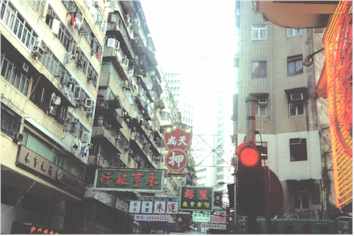
Kowloon and Central were both districts for shopping- there were shopping malls on both sides. Hong Kong was an amazing place for buying and selling. There were always new arrivals coming into the shops! It would be impossible to afford all the shopping if you did not have a job. I knew some people who had a "day job", say working in a bank, who also had a part-time job in the evenings and at weekends. To damage Hong Kong, all mainland China would have to do is cut off the ports to stop the imports and exports, but this would be foolish as Hong Kong is China’s port as well.
Hong Kong was a great place: it didn’t take me long to settle in- I liked the way the people were always in a hurry- so am I! It was strange to see all the activity on a Sunday when Great Britain is so quiet then. I woke up at seven a.m. on Sunday morning and the streets were already teeming with people busily going about their lives.
There were a lot of couples on the street, mainly two Cantonese people together. The girls were wearing a lot of make up but still looked younger than the guys but it was hard to be sure. People seemed to have both their business and their personal relationships well organized in Hong Kong- economic and social factors were taken care of and politics didn’t matter. The thing that annoyed me most about Hong Kong was not the number of people on the street but the fact that the streets were full of venders, carts moving goods, road works etc. as well as people! Pedestrians had it quite tough- as bad as vehicles did in China with all the bikes and carts.
I think that the street theater and hustle and bustle were such a part of people’s lives in Hong Kong because property was quite expensive and so it was fairly usual for several generations of a family to share the same home space. I visited a friend’s home and it was very cramped because it was quite small and being used partly as a storeroom for storing their business goods.
COURIER COMPANY
I visited a courier company on Kowloon side and went into the staff canteen where there were signs on the notice boards about company policies. A range of topics was covered such as:
rewards for combating dishonest
employee referrals for situations vacant
environment protection
rewards for sales leads generated by non-sales people
a mission statement and
appearance guidelines. These stipulated that women’s hair could not be longer than shoulder length.
All of these policies apart from that regulating appearance appeal to me. I do not see how it can matter how long a female employee chooses to wear their hair- to customers or colleagues or anyone else. Certainly it makes sense for employees to be rewarded for doing things that help the company that they may not be directly responsible for or otherwise incentivized about. For example, situations vacant and sales referrals, as everyone has a social network of friends, relations and neighbors outside of work who could be suitable as customers or employees of the company.
LANTAU ISLAND
I personally preferred the open, green places in Hong Kong such as the Chinese University in the New Territories and Discovery Bay on Lantau island where it was just easier to stop and think. The later was just a short ferry ride away from Central.
 |
On the island, there was a quiet beach that was rarely occupied by any or many other people and a shopping center with all sorts of shops that islanders would need- a McDonalds, a 7-11 convenience store, supermarket, newsagents, even an inexpensive restaurant serving a wide range of Chinese foods. Lantau was apparently a private island where property was expensive- I saw some notices saying that many of the island facilities were only available to residents. But it was great to have the beach and the shops so close to each other (a tropical version of Espoo, Finland!) and some peace and space to think and reflect and relax. I often took a book over to Lantau and sat back and read and relaxed.
UNORGANIZATION RATING
HUMANITY: 1.5. People in Hong Kong are not unfriendly. There was a distinct coolness towards me from strangers, but this was close to handover time.
QUALITY OF LIFE: 0.75. Probably more shopping per square meter than any other place on Earth! Privacy is scarce, work is hard. Customer service is good.
SAFETY: 2. A generally safe place because busy at all hours.
GOVERNMENT: 0.5. The Hong Kong government model under British rule of minimal government bar a safety net, with low income taxation at around 15%, was excellent. This rating has fallen since the handover to China and the continuous intervention in the foreign exchange markets to support the fixed exchange rate.
PROSPERITY: 0.75. People get to keep much of the wealth that they earn.
TOTAL: 5.5 out of 10. I liked Hong Kong a lot- I have not been back since the handover and don’t think I would enjoy it too much beyond the shopping- I am too conscious of fundamentals.
CHINA
I visited Southern mainland China towards the end of 1995. I applied for a two entry visa to China whilst in Hong Kong and took the ferry to Zhuhai, a special economic zone near Hong Kong on one trip and the train to Guangzhou on the other.
ZHUHAI
In Zhuhai, the main road out of the ferry port was brand new and had several lanes. However, there was little or no traffic using the infrastructure- apart from a few bicycles.
 |
I went into shops in the streets adjacent to that main road and the proprietors slept on beds in the corner. They looked surprised to see me when they woke up, and not just because I was an outsider- I don’t think they expected any customers.
I visited the Coca-Cola Zhuhai Bottling Plant and was asked to come back later that day to collect some pieces for my collection. In the meantime, I played some games machines in a couple of different video game arcades. These places seemed to be quite busy with young boys in particular. Every time a local child came to look over my shoulder to see how I was playing, an attendant in the video game arcade came and tapped them on the shoulder, quietly said something to them such that they then moved away. Clearly, any contact with this "foreign devil" was strictly forbidden. I wandered around a market which seemed to be the main means of commerce in the town. Certainly there were lots of goods of all kinds- metal parts, clothes, food and so on. Every stall seemed to specialize in something. I then had a meal in a restaurant just a couple of hundred yards from the Coca-Cola plant in a residential area. I pointed to something (green peppers and rice) in my Lonely Planet guidebook as the restaurant’s menu was understandably in Chinese only. Soon I had a wonderful meal, certainly one of the best I had in Asia. I was able to get a knife and fork too, not being adept with or a believer in chopsticks. After my meal, I tried to leave a tip under the fork but it was refused.
I then wandered around to kill some more time, and I walked over a modern bridge and came to a school where the children were all out playing in the playground. Shortly thereafter, the school broke up and the children started to pour out of the gates. I bought a lolly from a street vendor who literally dipped a stick into some sugary mixture. I had no change small enough so I ended up paying with a note and then promptly dropped the mixture onto the pavement. I can’t have made much of an impression on the inquisitive eyes of the dozen or so children who were watching. I walked further down the street and ended up buying a small ornament in the shape of a duck, which I gave to my mother. It is not that there were many street vendors of this kind- these were the only two that I saw on a long wide modern road.
I returned to the Coca-Cola plant and collected some nice pieces for my collection and then made my way back to the ferry station on foot. Taxi drivers hooted at me to get my attention to see if I wanted a lift, but I ignored them and continued on foot. I stopped at a caf' and was the only customer- the two waiters were playing cards. On the other side of the road was an American style bar- as I walked by, the door was opened by a waiter, perhaps to indicate to me that they were open.
All in all, I liked Zhuhai. Interestingly enough, I later read that the Chinese leg of the Formula 1 racing grand prix was due to be held there in 1999 (but was canceled for reasons unknown). I saw no other tourists and I have to assume that it is not a typical destination for tourists from Hong Kong. The people there were either neutral or friendly and never hostile- everyone treated me well or simply as a curiosity. I felt safe there on the modern streets, although I remain highly dubious as to how much actual business was taking place. It reminded me of a film set where there seemed like a lot of extras and people waiting around for the action to begin.
GUANGZHOU
As I mentioned, my other visit to mainland China was by train to Guangzhou, a special economic zone in the Guangdong province in Southern China. The pace was much more frenetic there and the stress level much higher. I took a taxi out to the local Coca-Cola plant- on the way, the driver pointed to "McDonaldo" and smiled at me. Cultural empathy!
I headed out into the suburbs to the Guangmei Foods Company which was a large factory making both Coca-Cola and a range of foods. Unfortunately, no one spoke English at all at the plant although the Deputy General Manager was very friendly and hospitable, giving me plenty of Coca-Cola of course! They placed a call to another Coca-Cola facility in the area and I was taken in a company car to that place where I met a Coca-Cola employee who had been seconded from Coca-Cola in Hong Kong and spoke excellent English. He arranged for me to go back to that first factory on the next day and invited me to make an unplanned overnight stay in Guangzhou and accompany him by car to Shenzen, a city close to Hong Kong, from where I could go back across the border. I took this rare opportunity and accepted his kind hospitality. The Coca-Cola people took me to a taxi rank and told me to keep out of sight whilst they bargained for the fare with the taxi driver.
I checked into a very tall modern hotel, the Guangzhou Furuma Hotel, with spacious, modern and advanced rooms. Maids and other people kept knocking on my door and offering me top ups of towels and other things from their carts, smiling and pointing. I soon realized that the only way to get any peace and quiet was to put the "Do Not Disturb" sign up outside the door. Each floor had a person near the lifts monitoring the comings and goings. I eat breakfast in the restaurant and was served by beautiful Chinese girls- I had a western style fried breakfast- but the sausage was horrible- it tasted as though it was full of paper! I then received notification that a fax had arrived for me and was awaiting my collection at the hotel business center- I got there to find that it was a query from the last occupant about a missing coat- it mentioned my room number. A charge appeared on my hotel bill for receipt of this fax! At least I know that correspondence was not being read by the hotel staff- they clearly did not realize that it was intended for them and not for me. I checked out of my hotel the next morning and the reception staff actually asked me to wait whilst they went and checked my room to ensure nothing was missing!!
I took this photo of Guangzhou city from my hotel room, which was high up. You can see the huge old church in the middle, which looks as though as it could easily have been transplanted from Europe. I also saw one large ornate temple in Guangzhou, as I sped by in a taxi.
 |
I did spend some time wandering around the very busy streets around the hotel and was stressed by the hustle and bustle- the sheer numbers of people walking around. You quickly learn that foreigners do not pay the marked prices! I eventually chose to eat in McDonalds- it was close and clean and cheap and convenient- I ordered my food in English! It was also quite empty- an older person was nurturing a cup of coffee and a staff member was entertaining a group of young children in the "Ronald McDonald" play house. Apart from that, all was calm and quiet. A couple of years later, I read an excellent book about McDonalds in Asia called "Golden Arches East", edited by James L. Watson (ISBN: 0804732078) which explained about the community and education role that McDonalds plays in China.
After leaving the hotel, I got into a taxi being driven by a young lady. The interior and exterior of the cab were immaculate- it reminded me of McDonalds! On seeing me, the driver immediately switched the radio over to a western radio station such that I got to listen to some catchy American music. The lady drove with a calmness that belied the road conditions, which basically consisted of a few brave motorists battling for road space with thousands of bicycles and many buses. She even anticipated the frenzied lane dodging of other people and keep us safe. Upon arrival at the Coca-Cola plant, I gave her a hefty tip. Her face instantly lit up and I am sure I probably paid her a full day’s wages or more. I only hope that she is still out there now, serving her customers with excellence, and running a large firm of taxis based on just those same simple but important principles- safety, comfort, cleanliness- as she did on that journey.
What did strike me looking at the young people in China was their lack of worry about what they are going to do. They stared out of bus windows with blank looks and had no sparkle in their eyes (or as my grandfather would say, "fire in their bellies").
Back at the Coca-Cola plant, a young lady was present as interpreter. We spoke quite a lot and she told me how much she would like to go abroad but that there were a lot of restrictions and regulations that made this unlikely. Here was an interpreter fluent in a language whose country she may never see at first hand. I was immediately conscious of my good fortune in being there able to travel relatively freely overseas and observe something of other people’s daily lives. I was given a tour of the plant and much of the bottling machinery was apparently imported from the USA judging by the manufacturer’s plates on the side. The other parts of the factory that I walked through to get to the bottling plant were much more labor intensive- a lot of people were employed there.
SHENZEN
Later that day, I met up again with the Coca-Cola person from Hong Kong and we drove in a car provided by Coca-Cola to Shenzen. He said that he had been telephoned by the people at the first plant only because the two companies were about to form a Sino-American joint venture and work together. I was driven on the main road between Guangzhou and Shenzen on the brand new motorway. Apart from ourselves, it was empty and all the road lights were switched off to save the electricity because none of the locals could afford the road tolls. You could see all the activity over on the side of the road. It would be better to lower or abolish the tolls on that new road, after all, it makes no sense to build modern and convenient infrastructure if it does not get used.
Closer to Shenzen, we passed through a security control but our passports were not checked- the window was wound down and the guard simply looked at me. All of the blocks of flats were pointed out to me and it was explained that people in Hong Kong had set their relatives up with flats to facilitate business between China and Hong Kong. Everyone had been rediscovering long lost distant relatives in the pragmatic nature of people from Hong Kong.
Shenzen city was a shock to me- for a start, we saw lots of homeless children begging on the street corners. I asked why bother with all the disadvantages of communism if you get the disadvantages of capitalist societies anyway. I was warned that I would see a lot more such children later at the railway station. I collected many things at the Shenzen Coca-Cola sales office and then a Coca-Cola van took me to the railway station where I could take a train back to Hong Kong. The customs procedures for entry to Hong Kong were all based at Shenzen station. I got through customs without incident, although I forgot to change the rest of my Chinese currency back into Hong Kong dollars- in fact, I believe that it is illegal to export the Yuan currency out of China.
An advertising man from Singapore was standing in the customs line and saw all the Coca-Cola materials that I had and we got talking about it. On the train back to Hong Kong, the Singaporean advertising executive pointed out the blocks of flats we were passing on the Hong Kong side and laughed and said "Do you know how many people live in those tiny spaces?". I replied that at least the people in Hong Kong owned their own property, unlike those of Singapore where property is predominantly government owned. I would rather live in a my own garage than a palace provided by the public sector.
All in all, I liked Zhuhai better than Guangzhou and Shenzen. China was not a bad place- chaotic and difficult to communicate as you would expect, lots of busyness, but how much business?
UNORGANIZATION RATING
HUMANITY: 1.5. I found some friendly people in the restaurants and factories. Children were warned off from me though.
QUALITY OF LIFE: 0.5. Plenty of caf's and restaurants for people to kill time in. Places like Zhuhai seem to have a more convivial environment than those like Guangzhou. People are poor, and problems attributed to capitalism such as homelessness are present here too.
SAFETY: 1. I did hear that it is a capital offense to kill foreigners which may explain my feeling of safety. Clearly where secret police are widespread, superficial safety can quickly lead to arbitrary imprisonment.
GOVERNMENT: 0.25. Communist, control freaks who do not tolerate freedom- of speech, belief, travel, family size and everything else that matters in life. Have allowed special economic zones and gradual economic reform.
PROSPERITY: 0.25. People are generally poor.
TOTAL: 3.5 out of 10. China’s government pervades all aspects of people’s lives. This is OK if you do not think and have infinite patience.
MACAU
During my trip to Hong Kong, I also took a ferry over for a day trip to Macau, an island that belongs to Portugal but reverts to Chinese mainland ownership and rule at the end of 1999. Macau is very much known for its gambling- casinos and so on.
Upon arrival, the first thing I did was visit the Coca-Cola plant. You could see the Chinese mainland from the plant- in fact there were bridges between the two in some places on the island.
 |
Having left the Coca-Cola factory, I was unable to get a taxi from this remote location, and ended up walking back and getting chased by a dog! I eventually got onto a local bus and asked for the center and made my way back to the casinos! That whole industrial area was very gray and quite untidy and rundown.
Back in the center, I remember sitting on a bench in a park where children where playing and large groups of old men were sitting playing games like chess. This was like a street scene in any of many places- especially Wuppertal in Germany- a little park surrounded by roads and blocks of flats and shops and caf's.
I then wandered around the main square and sat down on another park bench watching the people go by. They were very handsome- with golden skin and large eyes- clearly showing their European roots. A music concert was being held in the square (very much like the one I saw in Bratislava, Slovakia).
Later that evening, I took the ferry back to Hong Kong. I don’t think that there was a great deal to see or do in Macau unless you are interested in gambling and associated activities. I had an enjoyable day in Macau- as usual, if you want to, you can see the central renovated and attractive tourist and visitor areas, and the more run-down industrial and residential areas. Certainly, a day trip from Hong Kong to explore the shops and square and watch the people is well worth the effort.
UNORGANIZATION RATING
HUMANITY: 1. People’s behavior towards others is about what you would expect.
QUALITY OF LIFE: 1. Beautiful women, street concerts, park life.
SAFETY: 1.5. Macau is a reasonably safe place- apart from the dogs!
GOVERNMENT: 0.5. The cynical could view Macau from the year 2000 as being a communist-run casino venture. But as usual, the people are the redeeming factor.
PROSPERITY: 0.5. Average prosperity there.
TOTAL: 4.50. There are many worse places than Macau, and many that are better for unorganized people too.
Overall unorganization ratings for 1998
So where would a humanitarian-libertarian alien coming to Earth for the first time like to live?
| Overall Rating | Country | Country Rating (Out of 10) | Comments |
1. |
United States of America |
6.5 |
Scores high on humanity |
2. |
Finland |
6 |
Scores high on safety, living standards, Espoo. |
3. |
Slovakia |
5.75 |
Scores high on humanity, living standards |
4. |
Denmark |
5.5 |
Scores high on humanity, safety |
4= |
Hong Kong |
5.5 |
Scores high on customer service and safety |
6. |
England |
5.25 |
Scores high on humanity |
6= |
France |
5.25 |
Scores well across the board |
6= |
Germany |
5.25 |
Scores well across the board |
6= |
Norway |
5.25 |
Scores high on safety |
10. |
Ireland |
5 |
Scores low on safety |
10= |
Japan |
5 |
Scores high on safety and politeness, scores low on customer service and respect for females |
10= |
Portugal |
5 |
Scores solidly across the board |
10= |
South Africa |
5 |
Scores high on humanity, low on safety |
10= |
Sweden |
5 |
Scores highly for safety |
15. |
Czech Republic |
4.75 |
Scores fine across the board |
15= |
Macau |
4.75 |
Scores fine across the board |
15= |
Poland |
4.75 |
Scores solidly across the board |
18. |
Belgium |
3.5 |
Scores low on humanity |
18= |
China |
3.5 |
Scores OK across the board |
20. |
Hungary |
2.5 |
Scores low on humanity |
There are some surprises here at both the top and the bottom of the list. I think that this is caused by my heavy emphasis on humanity- on the way that people can and do interact with each other. Safety too is an important consideration- European cities, particularly in continental Europe and Scandinavia, are relatively safe and therefore score highly in this category. Certainly, there is not a strong correlation between prosperity and unorganization- Belgium, Sweden and Japan amongst others are relatively prosperous, but rate lowly in the unorganization ratings. Some skeptics about unorg may see this as evidence that unorg does not lead to prosperity, but I would retort that we need new ways to grow in today’s world, different ways from yesterday. Unorg also holds that prosperity is only a means to an end- the end being humanity and safety and those things.
Traveling around to these different places, a number of similarities can be seen:
AMERICANIZATION
In many places, there remains an interest in America and all things American. This Americanization extends beyond American cultural icons such as Hollywood, Coca-Cola, Marlboro and McDonalds and now encompasses American infrastructure such as out-of-town malls, highways, multi-screen cinemas and drive-through restaurants.
I saw this Americanization of infrastructure in places such as Nagano, Japan, Drogheda, Ireland and Midrand, South Africa. The influence of American culture was particularly strong in Leuven, Belgium with its Celebrities American bar, Poland with, for example, its Americanized eateries near to the Marriott Hotel in Warsaw- where there is both "Someplace Else", an American bar as well as a sports caf'. Even Newbury has its Chicago Rock Caf', an "eatertainment" dinnery replete with Americana.
CAF' SOCIETIES
Increasingly, there are clusters of public places for eating and drinking where people can get together for a coffee and a chat and a baguette. These places are often traditional caf's in Eastern Europe, quick service restaurants in the USA, small cool restaurants in Scandinavia, coffee bars where tired commuters grab a shot of caffeine in London and so on. Collective, public, convenient spaces are on the increase, fueling opportunities to see and be seen, and meet and be met by friends and strangers alike.
TRAFFIC
Road traffic congestion is bad is many places- it can be terrible in some European cities such as Lisbon and Warsaw, as well as places such as Atlanta in rush hour. Scandinavia scores highly in this area, because it has completely pedestrianized shopping areas and well built up public transport systems- comprising airport shuttle buses, trams, trains and buses. Unfortunately, many parts of the world still naively equate having a car and what it is and its age with being a status symbol. This is the case in regions such as Eastern Europe and Asia in particular.
STILL INSTITUTIONS NOT INDIVIDUALS, PROCEDURES NOT PEOPLE
Universally, governments tax citizens highly and let citizens down and hinder the creation and retention of prosperity. This is a near universal factor that reduces each country’s unorganization rating. Hong Kong had the least interventionist government, although it has slipped back since the handover from British to Chinese rule. Bureaucracy and work inflexibility are widespread too- people still typically commute to offices for work- and arbitrary rules and form-filling are everywhere. Customer service is routinely appalling, with customers barely given much attention or thought and routinely treated as a nuisance or cattle to be moved around at the seller’s convenience. These are the areas where the scores can be improved.
UNORGANIZED UTOPIA IS…
Unorganized utopia with an unorganization rating of 10 would consist of a safe place free of all forceful acts such as theft, rape and assault and arbitrary acts such as discrimination and discretionary abuse of power. In unorganized utopia, people would be routinely friendly to each other be they strangers, overseas visitors or whoever. Customer service would be responsive, with employees cross-trained to help customers out and save them from queuing. People would be enthusiastic and hard-working and routinely and regularly work from home and live in communities where living, working and social amenities are located close to each other within walking distance and are well served by public transportation links. There would be little or no political government present- local services such as street repairs and refuse collection would be organized and carried out by local people so that value for money and earmarked expenditure on specific projects could be calculated. I am not a fan of China’s market-based socialism, nor Japan’s conglomerate-based communitarianism nor Germany’s social market economy. There would be a range of private sector delivered entertainment, cultural and educational establishments- different things for people to see and do that change regularly. Telecommunications- mobile and fixed- would be widespread- everyone would have a mobile phone, email address, Internet connection and so on, and this would be the backbone facilitating routine, easy and convenient remote communication for personal and work purposes. I am still looking for this unorganized utopia and trying to bring it about. I travel around seeking pockets of bliss- people and places where humanity rides high and government low.
Feedback
Feel free to contact the author of this book, Simon Buckingham, via email at simon@unorgan.com with your feedback- comments on these or other places. The Unorganization Ratings will be updated annually as things change. "Unorganization: The Global Handbook" at www.unorgan.com is complementary to this book- it contains descriptions of Chinese and German societal patterns for example and other background theory to add to this material.
Appendix: Travel Schedule
Below is a list of all the places Simon Buckingham, the author of "Unorganization: The Travel Dispatches" had visited, complete as per the end of 1998.
Country |
Place |
Length of Visit |
Month |
Year |
Portugal |
Algarve |
2 weeks |
August |
1986 |
USA |
Florida |
2 weeks |
April |
1987 |
UK |
Jersey |
1 week |
August |
1987 |
Spain |
Costa del Sol |
1 week |
October |
1987 |
France |
Paris |
1 week |
April |
1988 |
| Germany via France and Belgium | Bonn |
|
July | 1988 |
Spain |
Minorca |
2 weeks |
August |
1988 |
Switzerland |
Lucerne |
5 days |
April |
1989 |
Spain |
Majorca |
2 weeks |
August |
1989 |
| USA Mexico |
California Tijuana |
2 weeks | April | 1990 |
| Germany via France, Belgium and Netherlands | Wetzlar | 1 week | July | 1990 |
Spain |
1 week |
October |
1990 |
|
Spain |
Madrid |
1 week |
September |
1991 |
USA |
Florida |
2 weeks |
July |
1992 |
Germany |
Wuppertal |
9 weeks |
October |
1993 |
Germany |
Wuppertal, Dusseldorf, Berlin |
6 months |
January |
1994 |
| The Netherlands | Amsterdam, Hague, Rotterdam | 3 days | April | 1994 |
France, Germany |
Paris, Dusseldorf |
1 day |
August |
1994 |
Spain |
Costa del Sol |
1 week |
September |
1994 |
| Switzerland | Geneva (staying in Annemasse, France) |
|
October | 1995 |
| Hong Kong, China, Macau (Via Dubai) | Hong Kong, Zhuhai, Shenzen, Guangzhou, Macau | 3 weeks | October | 1995 |
Czech Republic |
Prague |
10 days |
December |
1995 |
France |
Paris |
4 days |
March |
1996 |
USA |
Atlanta |
2 weeks |
July |
1996 |
France |
Paris |
2 days |
August |
1996 |
Germany |
Hanover |
4 days |
March |
1997 |
South Africa |
Sandton, Midrand |
10 days |
May |
1997 |
| Republic of Ireland | Dublin | 1 week | June | 1997 |
France |
Paris |
2 days |
August |
1997 |
USA |
Atlanta |
1 week |
August |
1997 |
Norway |
Oslo, Bergen |
2 weeks |
September |
1997 |
Germany |
Baden-Baden |
3 days |
September |
1997 |
Slovakia |
Bratislava |
2 days |
October |
1997 |
Poland |
Warsaw |
1 day |
November |
1997 |
Czech Republic |
Prague |
1 day |
November |
1997 |
Poland |
Warsaw |
1 day |
January |
1998 |
| Japan | Tokyo, Osaka, Kyoto, Nagano | 1 week | January | 1998 |
France |
Paris |
1 day |
January |
1998 |
Norway |
Oslo |
4 days |
February |
1998 |
Denmark |
Copenhagen |
4 days |
March |
1998 |
Poland |
Warsaw |
3 days |
April |
1998 |
France |
Paris |
2 days |
May |
1998 |
Poland |
Warsaw |
2 days |
May |
1998 |
Portugal |
Lisbon |
4 days |
May |
1998 |
Hungary |
Budapest |
4 days |
June |
1998 |
France |
Paris |
2 days |
June |
1998 |
Poland |
Warsaw |
2 days |
June |
1998 |
France |
Paris |
1 day |
June |
1998 |
Finland |
Helsinki |
2 days |
August |
1998 |
Sweden |
Stockholm |
2 days |
September |
1998 |
USA |
Florida, Atlanta |
2 weeks |
September |
1998 |
Belgium |
Brussels |
4 days |
November |
1998 |
Belgium |
Brussels |
1 day |
December |
1998 |
Ireland |
Dublin |
2 days |
January |
1999 |
